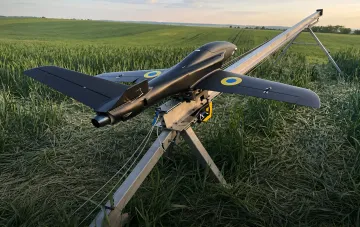
Ukrainian Defense Minister Evhenii Khmara told journalists that four potential interceptors capable of shooting down jet-powered "Shahed" drones have already been tested in the country. According to the head of the Ministry of Defense, field trials have been conducted on all four developments, and the key task at this stage is to bring these solutions to the required level of combat readiness as quickly as possible. "The search for countermeasures against jet-powered drones is ongoing. We already have four potential interceptors that can shoot down jet-powered 'Shaheds.' Field trials have already been conducted on them," Khmara emphasized, RBC-Ukraine reports.
From field trials to mass production
The Defense Minister clearly stated the target benchmark: after refining the developments, Ukraine intends to scale up production of the new interceptors to thousands of units. "The task is to bring these solutions to the required level as quickly as possible and scale production to thousands of units," Khmara stated. Thus, Kyiv is moving from the stage of experimental testing to industrial replication, signaling a transition of anti-drone defense to a qualitatively new level. Experts note that it is precisely the jet-powered "Shaheds" that pose the greatest threat to existing air defense systems, as their speed and maneuverability significantly exceed the characteristics of classic "motorized" drones.
Growing threat: Russia ramps up the pace of attacks with jet-powered UAVs
The context of Khmara's statements underscores the urgency of the task. According to data from Serhii "Flash" Beskrestnov, an independent advisor to the President of Ukraine on the development of defense technology areas, in July 2026 Russia launched around 1,500 jet-powered "Shaheds," and in August the number already exceeded 2,500 units. The growth rate is more than 60% in a single month, indicating a systematic rearmament of Russia's UAV air fleet from "motorized" to jet-powered models. The BBC previously noted that Moscow is deliberately converting "Shaheds" to jet propulsion, which radically changes attack tactics and requires Ukraine to review its entire air defense architecture.
Wave attack tactics against Kyiv
Andrii Kovalenko, head of the Counteraction to Disinformation Center, commented on the tactics of using jet-powered drones against the capital. According to him, Russia launches a relatively small number of jet-powered UAVs at Kyiv in waves, aiming to paralyze the operation of critical infrastructure and air defense systems. "The enemy does not have the resources for a large number of drones," Kovalenko noted. This means the adversary is forced to act in a targeted and economical manner, which in turn creates a window of opportunity for Ukrainian interceptors: with a limited number of waves, the effectiveness of even a small fleet of new air defense systems can be decisive.
Contradictory data
Open sources contain a certain discrepancy in assessing the scale of the threat. On the one hand, Beskrestnov operates with aggregate figures for the entire territory of Ukraine (1,500 in July, 2,500+ in August), indicating the mass nature of the attacks. On the other hand, Kovalenko emphasizes that a "small number" of drones is launched at Kyiv in waves, and that Russia allegedly lacks the resources for massive strikes. The difference in wording may be explained by the fact that the first source assesses the total volume across the country, while the second focuses on the tactics specifically toward the capital. Nevertheless, both versions agree on one point: the threat from jet-powered UAVs is growing, and Ukraine's countermeasures are systemic rather than targeted.
What's next: an industrial leap in anti-drone defense
Khmara's statement marks the transition of Ukraine's defense industry from "experimental development" mode to "serial production" mode. The mention of "thousands of units" as the target volume means that this is not about single prototypes but about creating a full-fledged production line. In conditions where Russia launches more than two thousand jet-powered drones monthly, the task of protecting airspace becomes unsolvable without a mass fleet of interceptors with comparable or superior speed. The next logical step, as expected, will be the publication of the interceptors' technical specifications, data on their range, speed and unit cost, as well as information on the enterprises where serial production will be organized.