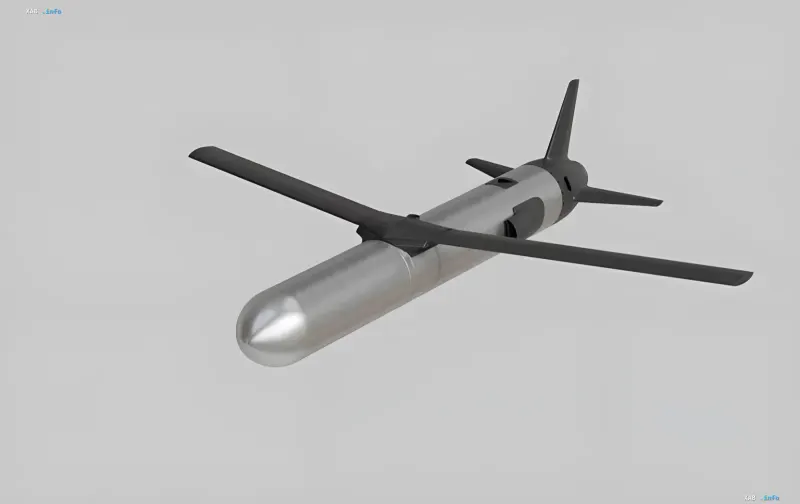
European startup Destinus, specializing in the production of cruise missiles, has announced the transition to mass production of its main product, the Ruta missile. According to the company, the total volume of missiles manufactured in Europe has exceeded 1,750 units, with monthly output reaching nearly 300 units. Destinus emphasizes that the current monthly production volume already exceeds the number of cruise missiles produced by the entire of Europe in a year prior to Russia's full-scale invasion. According to the company's management, these figures mark the project's transition from individual prototypes to a sustainable assembly line.
From Prototype to Assembly Line: Scale of Production
Destinus cites the rate of output as a key indicator of the project's maturity: about 300 missiles per month with a cumulative base of over 1,750 units. The company highlights that such a production rhythm no longer fits the framework of pilot batches and effectively forms one of the largest cruise missile product lines in Europe. For the industry, this means that the Ruta has ceased to be an experimental sample and has become a serial product with a predictable shipping schedule.
The Engine as a Bottleneck
Destinus CEO Mikhail Kokorich noted that starting next year, the company will be able to meet demand in Ukraine and Europe for turbojet engines with a thrust of about 1.5 kilonewtons, which are used in cruise missiles. According to him, the mass production of such engines has already been established, and the company supplies them not only for its own missiles but also for other manufacturers. Thus, the engine, which is traditionally a limiting link in cruise missile production, ceases to be a bottleneck for both Destinus itself and related developers.
Combat Deployment and the Transition to Ruta-2
Combat use of the Ruta missiles became known in October 2025, when Ukrainian President Volodymyr Zelenskyy announced that these missiles had already been used in real operations. It was previously reported that Ukraine successfully tested the Ruta missile, capable of speeds up to 500–800 km/h. Against this backdrop, the company has started production of an improved version, the Ruta-2, designed for a 250 kg payload and a flight range of over 700 km. Unlike the current modification, the new missile is designed so that storage, transportation, and launch are performed from the same container, which, according to the company, simplifies logistics when accumulating large arsenals.
Strategy: Cheap Missiles vs. Ultra-Long Range
Commenting on industry trends, Kokorich spoke out against the growing attention to long-range weapons, arguing that cheaper missiles with a range of less than 1,000 km will make up the bulk of future demand. He also pointed out that as missile stockpiles grow, the main challenge for Europe is no longer production, but military integration — that is, the ability of consumer countries to embed new systems into their command structures and combat formations. Thus, Destinus's focus is shifting from the question of "how much can be produced" to "how quickly these missiles can be deployed and used".