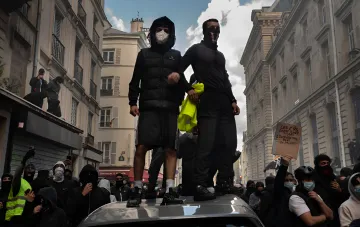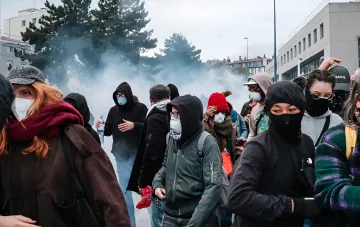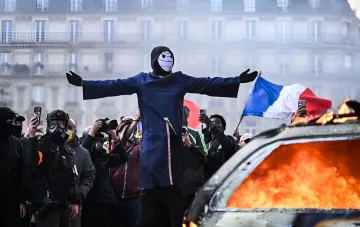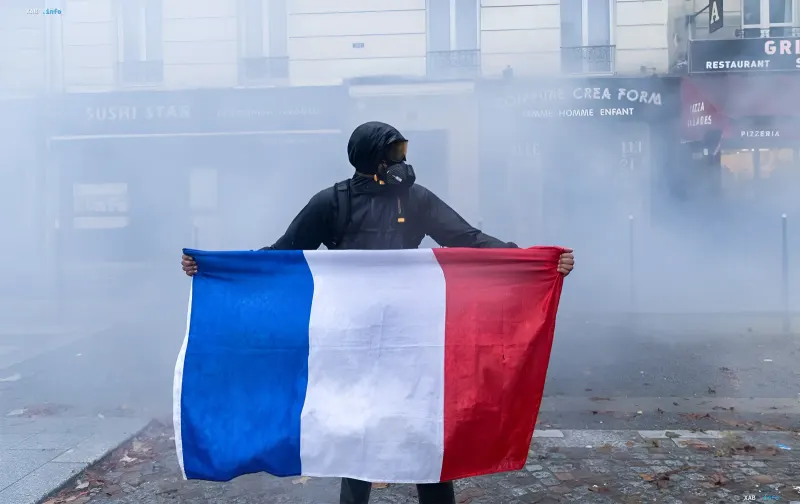
On Saturday, November 21, new street protests called by trade unions and the “yellow vest” movement took place in dozens of French cities. Demonstrators dubbed this latest wave of rallies “Act VI” and once again made fighting the rising cost of living their primary demand. However, according to participants and organizers, the turnout at demonstrations continues to shrink compared to previous Saturdays, pointing to a gradual waning of the movement's mobilization potential.
Paris: Short march and no serious clashes
The capital's procession ended its route at Place de la Nation about 40 minutes after starting — noticeably faster than in previous weeks. There were significantly fewer participants this time than on previous Saturdays. Nevertheless, a substantial number of demonstrators remained on the square, where brass bands played for them. Law enforcement officers cordoned off the area and took control of all roads leading to it, but no serious clashes or open confrontation with the police were recorded in Paris.
Marseille and Lyon: Broken bus stops and pre-imposed bans
In Marseille, the protest was not without incidents: participants smashed the glass of several public transport shelters. According to the police prefecture, the demonstration in the city gathered about 4,600 people. In Lyon, authorities had banned protests in the city center in advance, and according to organizers and several media outlets, the protest there effectively failed to materialize, with only a small number of demonstrators taking to the streets. At the same time, according to Le Progrès, mobile police units dispersed unauthorized columns on Garibaldi Street and Gambetta Boulevard, using tear gas several times, while additional forces were sent to Bellecour Square, where a Christmas market had opened.
Nantes: Route deviation and participant injury
The most tense situation unfolded in Nantes. According to Ouest-France, a group of demonstrators attempted to deviate from the agreed route, after which confrontations with the police began. Law enforcement officers used tear gas, and one of the protesters, according to CNEWS, sustained a leg injury from a police stun grenade. Thus, unlike Paris, the sixth wave escalated into localized clashes in several cities.
Context: Declining activity and the question of external ties
The drop in turnout for “Act VI” is a key signal for observers: the movement, which began with mass marches, is gradually losing its reach, although it retains the potential for incidents in certain cities. It was reported earlier that France intends to investigate Russia's potential involvement in the street protests, and Volodymyr Kurennyi, deputy general director of RBC-Ukraine, analyzed in a separate column how the current rallies differ from previous waves. The combination of these factors — falling turnout, local clashes, and the discussion of the external context — determines the further dynamics of the protest cycle in France.