On Saturday, October 31, 2026, France saw the 'third act' of nationwide protests that this year brought together trade unions, high school students, university students, the 'yellow vests' movement, and left-wing activists. According to the Ministry of the Interior, about 320,000 people took to the streets across the country—fewer than the previous weekend when demonstrations drew approximately 410,000 participants. In Paris, about 70,000 people protested, and around 150 demonstrations took place nationwide. The catalysts for the protests were rising prices, deteriorating public services, and the policies of Emmanuel Macron's government.
Halloween masks and anti-government banners
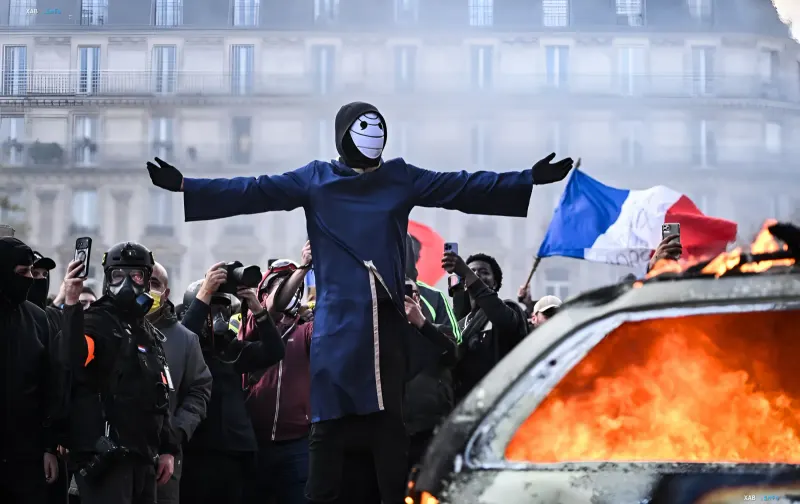
The coincidence of the date with Halloween left its mark on the participants' appearance: some demonstrators came in costume, carrying banners criticizing the government and living conditions in France. Photos from the protest show people in masks and dark clothing, the French tricolor, and, in the foreground, a burning car. Reports indicate that after peaceful marches ended, groups of masked individuals joined the crowd, as seen in previous protests, which triggered escalation.
70,000 security forces and a 'very high risk' warning
Authorities had prepared in advance for potential unrest. Interior Minister Laurent Nuñez announced that 70,000 police officers and gendarmes, including elite units, had been deployed to maintain order, warning that Saturday could be a day of 'very high risk.' The Paris march started at Porte de Bagnolet near the ring road, moving toward Porte de Charenton while bypassing the city center, as a helicopter flew overhead. Initially, the march was peaceful, but the situation escalated near the end of the route.
Paving stones, incendiary devices, and tear gas
Near the endpoint of the route, dozens of people in masks and black clothing used hammers to pry up paving stones and hurl them at police officers, and at least one incendiary device was thrown at the security forces. Police responded with tear gas and batons. The Paris prefecture stated that a group of several hundred rioters attacked law enforcement with various objects, prompting officers to take measures to restore order. Minister Nuñez described the level of violence as 'extraordinary' and considered the throwing of a Molotov cocktail at a special unit officer to be attempted murder.
565 arrests and injured officers beyond the capital
By the evening of October 31, the Interior Ministry reported 565 arrests nationwide; in Paris, four police officers and one gendarme were injured during the clashes. Clashes also occurred in other cities: in Lyon, protesters hurled objects at police, who responded with tear gas, while in Toulouse, security forces used water cannons to disperse an unauthorized rally of several thousand people, mostly youth. In several other cities, police also deployed tear gas and flash-bang grenades.
Context: the second wave of protests in a week
The previous wave of nationwide protests in France took place on October 24, when over 400,000 people took to the streets. While the Paris march involving about 110,000 demonstrators was peaceful, clashes broke out in Nice, Lille, Toulouse, and Nantes, with police deploying tear gas and water cannons. Thus, October 31 marked the continuation of a mounting cycle of street protests that has periodically affected the school environment over the past two weeks, where authorities reported that hundreds of high schools had been blocked or preventively closed.