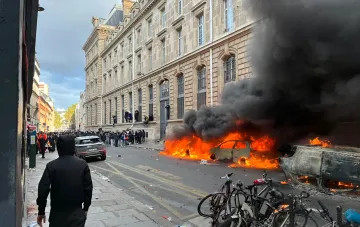
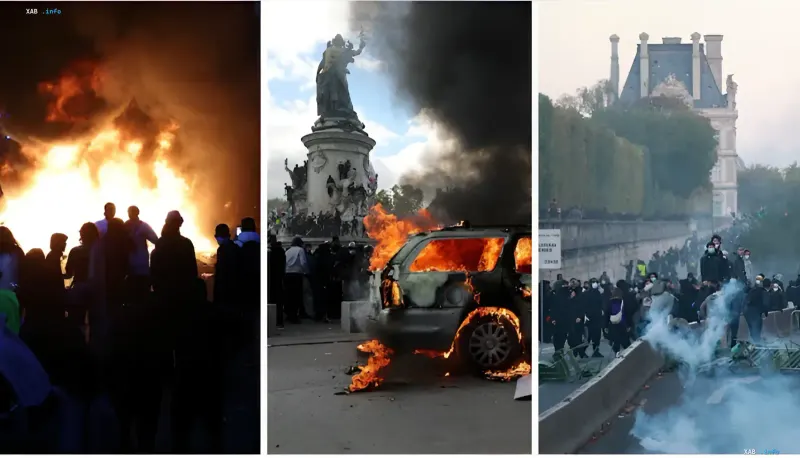
On Saturday, October 17, France experienced one of the most tense days of protest activity in recent years. Demonstrations that began as student rallies against the state of schools escalated into a nationwide movement involving labor unions and groups dissatisfied with the rising cost of living and declining quality of public services. By evening, the situation in a number of cities spun out of control: buildings and cars were set on fire, stores were looted, and police clashed with demonstrators. Paris was shrouded in tear gas smoke by nightfall, while fires and acts of vandalism were reported across the country.
Scale and Dynamics: From Peaceful March to Evening Violence
According to Interior Minister Laurent Nunez, about 550,000 people took to the streets across France, including approximately 110,000 in Paris; protest organizers cite higher figures. The main demonstration in the capital in the afternoon was generally peaceful, but by early evening the situation deteriorated sharply. Several groups of protesters set fire to streets and cars near famous landmarks, including the Place de la Republic, and clashed with riot police units. As a result, more than 1,200 people were arrested, and Prime Minister Sebastien Lecornu reported that 150 police officers were injured in the clashes.
From Lycees to Nationwide Movement
The root of the protests was discontent with the state of French lycees, attended by teenagers aged 15–18: in recent weeks, hundreds of thousands of students had protested against teacher shortages and dilapidated buildings, accusing the government of failing to solve these problems. The movement quickly gained support from trade unions and other groups protesting the rising cost of living, uniting people with a wide variety of demands. The government attempted to defuse the situation: Education Minister Edouard Geffrey promised in an October 8 television interview to increase staff by 3,000 teachers, but protests continued to escalate.
Chronicle of Destruction Across Cities
The destruction affected more than just the capital. In Paris, clothing and grocery stores were attacked, and at least one restaurant was burned down. In Bordeaux, protesters looted a Louis Vuitton store, in Lille they broke into an Apple store, and in Lille and Marseille, government buildings were reportedly attacked. In Lyon, the city's tourist office burned down, an event Mayor Gregory Doucet called a tragedy. In Limoges, a major fire at the city hall building led to the collapse of part of the roof, and damage to residential buildings was recorded in Grenoble, Avignon, Pau, Montpellier, and Valence. Footage from Grenoble showed a tourist train driven by masked individuals rushing down a narrow street toward at least three riot police officers.
Government Reaction and Political Context
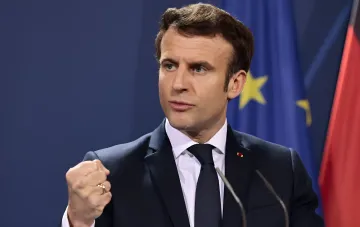
The Interior Ministry stated that "deliberate acts of violence" were committed by "masked individuals" in several districts of Paris, as well as in Marseille, Rennes, Toulouse, and Angers. President Emmanuel Macron condemned those involved in arson, looting, and attacks on public buildings and vowed to bring them to justice: "Those who smashed and attacked police stations and businesses, and even looted town halls, will be held accountable and punished." Prime Minister Lecornu, in turn, accused certain groups of using the protests as a "warm-up" before the presidential election and stressed that "no one can impose their political agenda through violence." The Paris Police Department stated that officers "will not back down in the face of rioters."
Elections as a Background for Escalation
The unrest has heightened political divisions ahead of the presidential election scheduled for April next year, when the incumbent president's term expires. Leading candidates include Marine Le Pen of the right-wing National Rally party and Jean-Luc Melenchon of the left-wing France Unbowed party. Against this backdrop, the violence on October 17 is seen in Paris as an attempt by certain groups to impose their own agenda during the electoral period, increasing pressure on the government and highlighting the depth of the socio-political crisis in France.