Since its founding in 1958, the National Aeronautics and Space Administration (NASA) has launched hundreds of research programs, each becoming a milestone in human history. By 2026, as we stand on the threshold of a new era of space exploration, reviewing past achievements allows us to understand the scale of the transformation that science, engineering, and our perception of the Universe have undergone.
Manned Flights: From First Steps to Returning to the Moon
Early NASA programs focused on proving the possibility of humans living and working in weightlessness. Project Mercury (1958–1963) became the first American manned flight program, which not only proved the possibility of human presence in orbit but also laid the foundation for future missions. In 1961, Alan Shepard became the first American in space, and a year later, John Glenn performed the first orbital flight, opening the era of regular manned flights.
Project Gemini (1961–1966) became the technological bridge to the lunar program. During these missions, scientists mastered key skills: orbital maneuvering, docking of spacecraft, long-duration flights, and spacewalks. These achievements became the basis for the historic Apollo 11 mission in 1969, when Neil Armstrong and Buzz Aldrin first stepped on the surface of the Moon. This moment became a symbol of the triumph of the human mind and technological progress.
In 1973, the first American orbital station, Skylab, was launched, confirming the possibility of long-term living and working of astronauts in space. This station laid the foundation for the construction of the International Space Station (ISS), which continues to function to this day. In 2022, the Artemis I mission marked the beginning of a new era of returning humans to the Moon and the upcoming preparations for a flight to Mars.
Automated Stations: Unveiling the Secrets of Other Planets
NASA's automated stations and rovers have revealed details of the structure of other planets and their moons, providing humanity with unique data about the Universe. Viking 1 (1975–1982) became the first spacecraft to successfully land on the surface of Mars, taking the first photos of the soil and conducting the first biological tests. These data became the basis for further research of the Red Planet.
Voyager 1 and Voyager 2, launched in 1977, provided detailed images of Jupiter, Saturn, Uranus, and Neptune. Today, Voyager 1 is the first man-made object to have exited into interstellar space, continuing to send data from a distance of more than 24 billion kilometers from Earth. Mars Pathfinder (1997) delivered the first rover in history, Sojourner, to Mars, proving the effectiveness of relatively inexpensive robotic research.
Cassini-Huygens (1997–2017) thoroughly studied Saturn and its moons, discovering water geysers on Enceladus and methane lakes on Titan. Spirit and Opportunity (2003–2019), twin rovers, gathered evidence that liquid water once existed on Mars. Interestingly, the Opportunity rover operated for almost 15 years instead of the planned 90 days, becoming one of the most successful projects in NASA history.
Curiosity (2011–present) is a mobile laboratory that confirmed that bodies of water existed on Mars that once supported life on the Red Planet. Perseverance and Ingenuity (2020–present) continue this work: the rover is looking for signs of ancient life and collecting soil samples to be sent to Earth, while the Ingenuity helicopter performed the first controlled flight in the atmosphere of another planet in history.
Telescopes and Transport Systems: A Glimpse Deep into the Universe
Astronomical observations and the development of transport systems have taken the study of the Universe to a new level. The Space Shuttle Program (1981–2011) — a program of reusable spacecraft that carried out 135 missions, ensuring the launch of satellites into orbit, the construction of the ISS, and the servicing of telescopes. This program became a symbol of US technological superiority in space.
Hubble Space Telescope (1990–present) — a cult orbital telescope whose observations helped refine the age of the Universe, confirm the existence of black holes, and discover thousands of new galaxies. Its data became the basis for many scientific discoveries of recent decades. James Webb Space Telescope (2021–present) — the most powerful infrared telescope, studying the first galaxies after the Big Bang and analyzing the atmospheres of exoplanets. Its discoveries continue to change our understanding of the Universe.
Contradictory Data
While most NASA missions have received widespread recognition, there are some controversial points. For example, critics point out that some projects, such as Artemis I, face delays and budget overruns. Supporters of the program argue that these problems are temporary and related to high safety standards. Other experts believe that resources could have been directed to more priority tasks, such as studying Earth's climate or developing technologies to solve global problems.
There are also disagreements regarding the interpretation of data obtained from Mars. Some scientists believe that the traces of water found do not necessarily indicate the presence of life, while others see in this potential evidence of the existence of microorganisms in the past. These discussions continue and stimulate further research.
The Future of Space Exploration
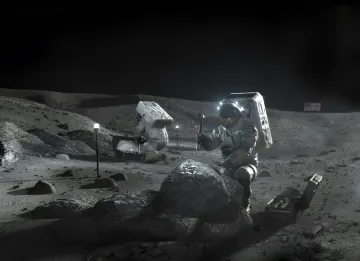
By 2026, NASA continues to develop its programs, focusing on new challenges and opportunities. The Artemis II mission is scheduled for 2025, and Artemis III for 2026, which will allow humans to return to the Moon. Future plans include the creation of a lunar base and preparation for a flight to Mars. Automated missions, such as Europa Clipper, will study the moons of Jupiter, and new telescopes will continue to expand our knowledge of the Universe.
In conclusion, NASA missions have not only redefined science and engineering but have also inspired millions of people around the world. Their achievements have become a symbol of the human desire for knowledge and overcoming boundaries. In the future, when we look at the stars, we will remember those who made this step possible.