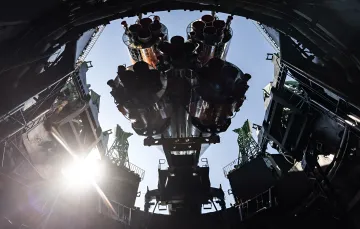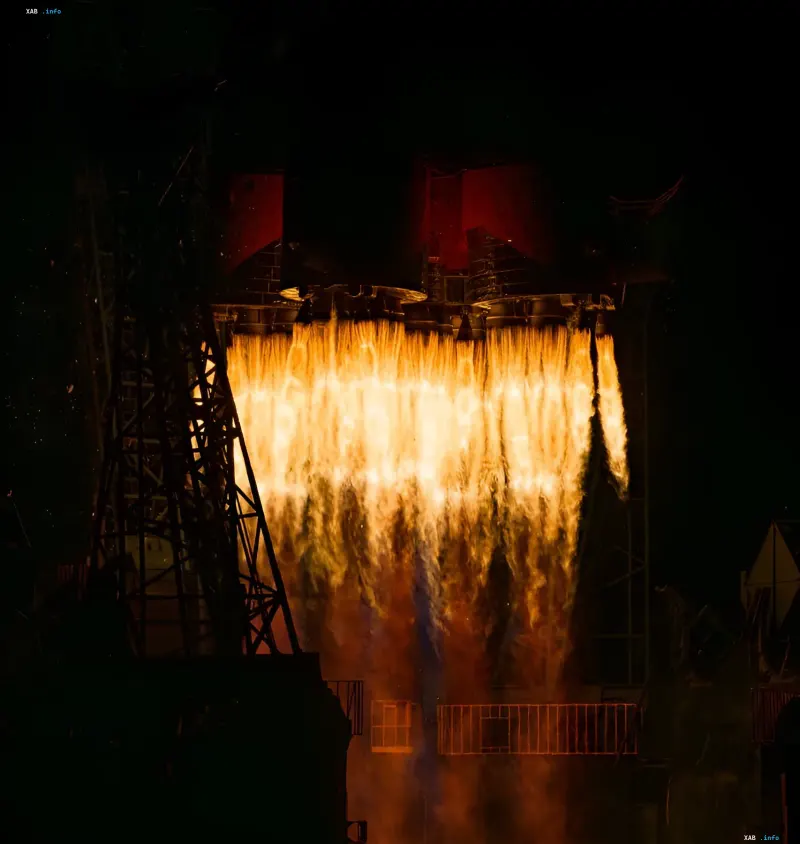
In the world of aerospace photography, there is an eternal dilemma: capturing the power of a rocket launch without losing details in the blinding glow of the flame. Photos taken by conventional methods often turn the rocket plume into a structureless patch of light. However, Roscosmos specialists have found a solution to this challenge, demonstrating unique frames of a Soyuz carrier rocket launch where the exhaust structure is clearly visible.
Battle with the Sun's Brightness
The main difficulty in filming a launch lies in the extreme brightness of the engine flames. At the moment of launch, the light intensity is comparable to solar radiation. Standard photography methods are powerless here: if you simply close the aperture to its maximum values, the image loses sharpness due to light diffraction. Using neutral density filters also does not yield optimal results, as they merely darken the image without solving the dynamic range problem.
To overcome these limitations, photographers used an extremely short shutter speed — 1/32000 of a second. It was this parameter that allowed them to "freeze" the rapidly moving gases and capture their structure, which usually remains invisible to the human eye and standard cameras.
Physics of Exhaust and Speed of Light
The exhaust velocity of gases from the Soyuz engine nozzles reaches colossal values — about 2800 meters per second. At such speeds, even a shutter speed of 1/8000 of a second, considered very short in classical photography, leads to noticeable motion blur. Only the transition to 1/32000 of a second allowed minimizing this effect and obtaining a crystal clear frame.
The resulting photos reveal an amazing picture: almost transparent jet streams and bright tongues of flame, which are usually perceived as a single mass of fire. Roscosmos clarifies an important physical nuance: those very bright tongues we see in the photo are actually kerosene burning out in the atmosphere. This fuel was previously used to cool the combustion chamber and engine nozzle, and at the moment of launch, it is ejected and ignited.
Technical Parameters of the Masterpiece
To create these frames, a specific combination of camera settings was chosen to balance exposure and shutter speed. The final shooting parameters were as follows:
- Shutter Speed: 1/32000 second
- Aperture: f/16
- ISO Sensitivity: 64
Using a low ISO sensitivity of 64 allowed avoiding digital noise, while the f/16 aperture provided the necessary depth of field without introducing critical diffraction. The result was a series of images revealing the technical beauty and complexity of the processes occurring during a carrier rocket launch.