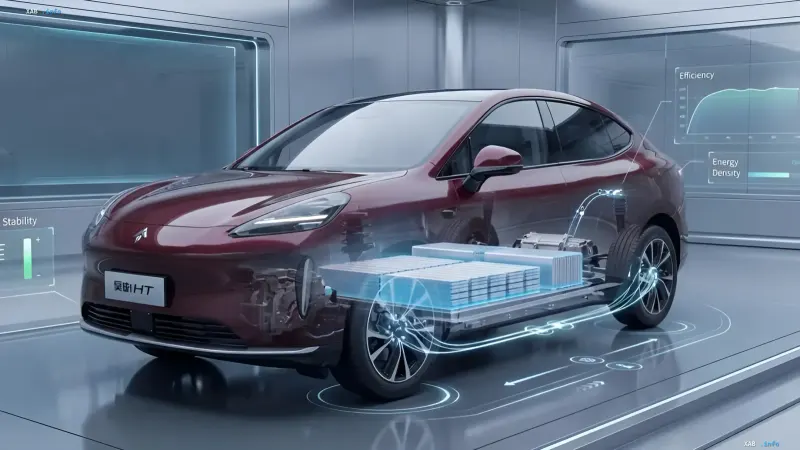
At the Guangzhou Auto Show on November 27, 2026, Chinese automaker GAC unveiled its next-generation traction battery, the Magazine Battery 3.0. The company's key claim is the battery's ability to withstand a hand grenade detonation directly beneath the vehicle's floor without catching fire or suffering cell destruction. For a visual demonstration, GAC engineers, in cooperation with the China Automotive Technology and Research Center (CAERI), conducted a live test right on the exhibition stand: an explosive charge was detonated beneath the floor of a test vehicle, with the condition of the battery and body assessed in real time.
Grenade Test: What Happened Underneath
During the demonstration, a Type 82-2 grenade containing about 62 grams of TNT equivalent was detonated under the vehicle's floor. According to GAC, the explosion deformed and pierced the external steel protective floor plate, but the battery cells did not catch fire and maintained their integrity. Following the test, the vehicle's doors automatically unlocked, and the car was able to power on, which the company interprets as confirmation that the safety and management systems remained operational even after extreme damage.
Series of Impact Tests: 13 Times Higher Than National Standards
In addition to the explosion, the battery underwent a series of underside impact tests with energy ranging from 150 to 2,000 joules, as well as high-speed obstacle contact checks on the floor. For comparison, the current national Chinese safety standard for electric vehicle batteries requires an impact test with 150 joules of energy. Thus, the maximum load in GAC's tests exceeded the regulatory requirement by more than 13 times, which the company positions as a significant margin of safety far beyond mandatory requirements.
Extreme Explosion Parameters and the Purpose of the Test
According to the company, in the explosion impact zone, temperatures exceeded 2,800 °C, and fragments scattered at a speed of about 1,030 m/s. GAC explains that such testing makes it possible to evaluate the battery's resistance to extreme damage in real-world scenarios—for instance, when driving over a large metal debris or a concrete block at high speed, when the underside experiences shock and thermal loads comparable to military testing.
Multi-Level Casing Protection and Damage Sensors
Battery protection is implemented at multiple levels. A multi-layer underside shield absorbs impact energy and prevents sharp objects from penetrating the cells. Elastic wave sensors are built into the casing to monitor unusual vibrations during severe impacts and can immediately warn the driver of damage. Additional reinforced zones on the sides of the casing distribute collision energy, preventing it from transferring directly to the battery cells: in a side pole crash test at about 32 km/h, no deformation affecting the cells was recorded.
Leak Detection: Spotting a Leak in Three Seconds
Another feature of the Magazine Battery 3.0 is its sealing and liquid leak monitoring system. According to GAC, it is capable of detecting damage measuring about 2 mm within three seconds and initiating an automatic fluid drain to reduce the risk of a short circuit after an accident. The company presents the combination of these solutions as an answer to the main fear of electric vehicle owners—thermal runaway and battery fires in the event of casing damage.