An international team of astronomers has published a new gamma-ray source catalog in The Astrophysical Journal Supplement Series, covering the previously poorly studied 20–200 mega-electronvolt energy range. The 2FLE catalog includes 450 sources, more than doubling the result of the previous 2018 catalog, which recorded 198 objects in a narrower energy window. According to the publication, 60 of the discovered objects do not yet have confirmed counterparts in other radiation bands, and scientists have not been able to determine their nature.
Why the 20–200 MeV Range Remained a 'Blind Spot'
Gamma radiation is one of the key tools for studying the most energetic processes in the universe: with its help, astronomers observe matter falling into supermassive black holes and particles accelerating to extreme speeds. However, the gap between X-rays and high-energy gamma rays, namely 20–200 MeV, has long remained poorly researched. The main technical difficulty is that gamma photons cannot be focused with ordinary mirrors like visible light, making it extremely difficult to precisely determine the direction from which a signal arrives.
How the Fermi-LAT Telescope 'Catches' Gamma Photons
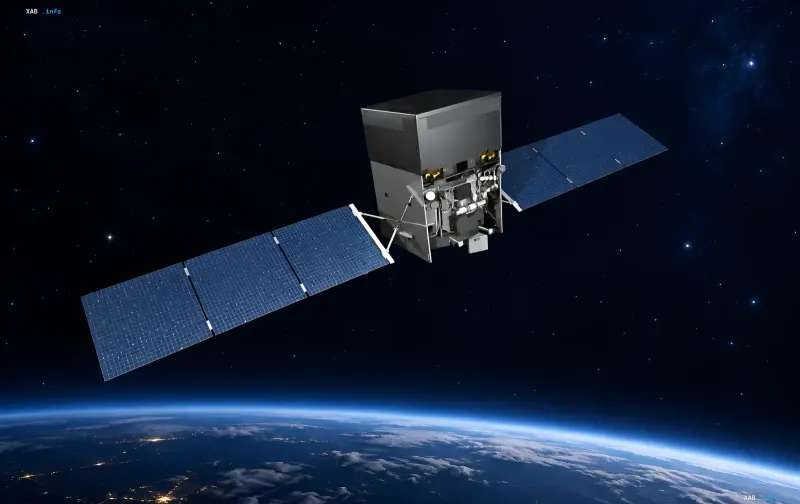
To work in this range, researchers used data from the Fermi-LAT telescope, which operates on a different principle: inside the device, a gamma photon interacts with layers of tungsten and decays into an electron and a positron, while silicon sensors track their trajectories, allowing the arrival direction to be reconstructed. The problem is that the lower the energy of the gamma ray, the more the particles deviate from their initial direction: at the lower bound of the range, around 20 MeV, the directional error can reach approximately 20 degrees. Because of this, it is difficult to distinguish whether a signal comes from a single object, from several neighboring sources, or from background radiation.
The 2FLE Catalog: 14 Years of Observations and 450 Sources
To overcome these limitations, scientists analyzed Fermi-LAT data spanning 14 years, excluding periods with failures and insufficient observation quality; about 10.3 years of data remained for statistical processing. Using methods that separate cosmic object signals from background radiation, the researchers compiled the 2FLE catalog. Correspondences in other bands were found for 377 sources: 325 of them are located outside the Milky Way, and 52 inside our Galaxy. Among extragalactic objects, flat-spectrum radio quasars dominate at 218, representing bright cores of distant galaxies powered by supermassive black holes, whereas in the Milky Way the majority of identified sources are pulsars—rapidly rotating neutron stars. Separately, scientists linked gamma emission to the globular star cluster M2 for the first time.
60 Objects Without Counterparts and the Role of New Observations
The most questions are raised by 73 sources for which no counterparts could be found in other bands: 13 of them already appeared in the previous catalog without an established nature, and another 60 were discovered for the first time, with 38 of them emitting particularly strong signals. At the same time, the authors emphasize that these are not necessarily 60 new types of objects: some signals may arise from the superposition of emission from multiple sources, and some objects are not yet recognized by their emission in other bands. New observations will help unravel the nature of these mysterious sources—in particular, the 2027 launch of NASA's Compton Spectrometer and Imager (COSI) telescope, which will study the adjacent 0.2–5 MeV range and complement the Fermi-LAT results.