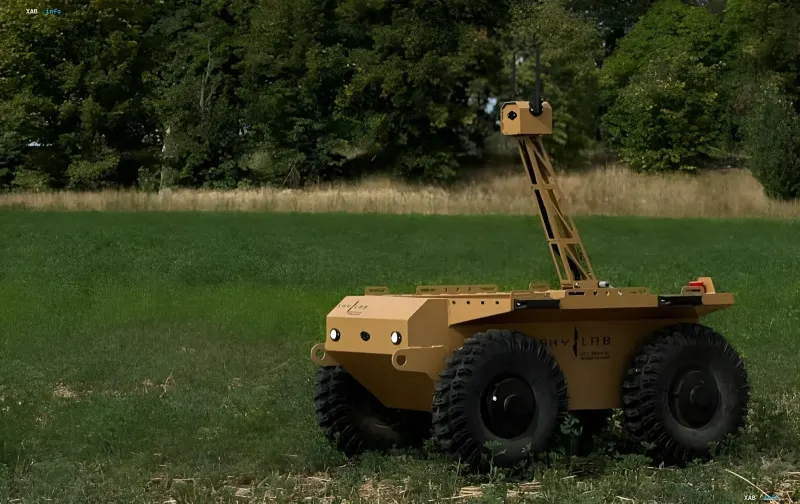
A week of negotiations within the framework of the UN Convention on Certain Conventional Weapons (CCW) in Geneva ended without achieving a key result: delegations failed to agree on a mandate for negotiations on a legally binding treaty regulating autonomous weapons. According to The Guardian, as cited by RBC-Ukraine, an overwhelming majority of states favored a mandate leading to a binding treaty, but the consensus requirement among the 128 convention participants forced the adoption of a significantly weaker document. As a result, participating countries were tasked with "developing by consensus" a text that may contain no legal obligations at all. For a convention operating on the principle of unanimity, this means that in the last 30 years, the CCW has not adopted a single new law on weapons regulation — and the current result was no exception.
Russia's role: intentional delay
The central obstacle to achieving a mandate was Russia's objections. Diplomats present at the talks told The Guardian that the Russian delegation intentionally delayed discussions and, in their assessment, did not act in good faith. It was the failure to withdraw these objections that made the adoption of a tough mandate impossible. The US delegation, in turn, according to participants, sought a compromise path toward a consensus statement, but under conditions where the consent of all 128 participants is required to adopt any document, even one stubborn voice is enough to block the process.
Who opposed binding law
Opposition to binding states with a new mandatory law came not only from Russia but also from a number of leading military powers actively developing artificial intelligence technologies in their armed forces. The US stated that the issue of human control over autonomous weapons was discussed at the APEC summit during meetings between Xi Jinping and Donald Trump, but they refrained from a binding treaty. South Korea, Japan, Turkey, the UK, France, and Germany also opposed the creation of a new mandatory act, favoring a non-binding agreement. Some delegates argued that existing international humanitarian law is already sufficient to regulate the use of autonomous systems.
Who insisted on new law
More than 100 states, conversely, insisted on adopting new international law, emphasizing that autonomous weapons systems create fundamentally new challenges not covered by existing norms. Support or readiness to support a new protocol was expressed by European countries and NATO members, as well as Ukraine, China, and Iran. A separate bloc of seven countries — Austria, Belgium, Brazil, Ireland, Mexico, New Zealand, and Panama — sought for the treaty to be negotiated within one year. The Brazilian delegate at the conference stated that autonomous weapons are not weapons of the future: they are already being used and developed, and regulatory efforts are already behind schedule.
Reaction of experts and human rights organizations
Future of Life Institute head Max Tegmark stated that world leaders have failed the task: "killer robots" already exist, and states have decided it is enough to just talk about it for the 14th year now. Senior arms adviser at Human Rights Watch Bonnie Docherty emphasized that autonomous weapons require binding law and rejected the US proposal to spend five years on negotiating a mandate, noting that treaties can be agreed upon in 15 months. One European diplomat stated that there was no political will to truly regulate the use of autonomous weapons, at least on a scale commensurate with the urgency of the issue. On the final day of the conference, the Egyptian delegation protested loudly against the exclusion of several countries that did not participate in the negotiations.
Context: from September amendments to Ukrainian practice
The current result in Geneva is not an isolated event. At the end of September 2026, RBC-Ukraine reported that the US and Russia removed from a draft UN document a requirement that a human must verify AI-predefined military targets before a strike. At that time, at a meeting in Geneva, US and Russian delegations spent about 15 hours introducing amendments to the text. In parallel, drone autonomy is actively developing in Ukraine: experts note that the operator increasingly sets tasks for a group of vehicles rather than piloting each one manually. Manufacturers expect reconnaissance drones to fly without an operator, but the decision to strike will remain with a human. Ground-based robotic complexes are going through a similar path, currently performing missions under operator control but demonstrating an increasing degree of autonomy in tactical decisions.