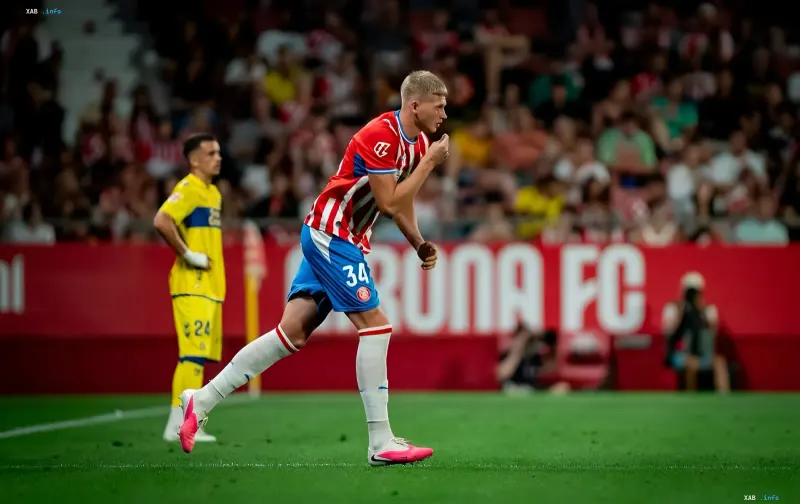
Girona head coach Kike Alvarez publicly commented on the squad situation in the Catalan team's attacking line, emphasizing that he has a set of versatile strikers for various game scenarios. In his words, conveyed by Mundo Deportivo and recounted by Sport RBC.UA (www.sport.rbc.ua), the names of Ukrainian legionnaires Vladyslav Vanat and Oleksandr Pishchur, as well as experienced forward Marco Stulani, were specifically mentioned. According to the coach, it is precisely the combination of different types of attacking players that allows him to flexibly build up play from match to match.
Versatility of attack as the main trump card
When asked about the choice of players at the tip of the spear, Alvarez focused not on a single "main" striker but on the depth and variety of the squad. "I can say about the future — Pishchur has shown that he can help us. As for Stulani, he remains one of the best forwards in the championship this season. I am glad that I have three versatile forwards for different situations," the coach stated. Thus, in his rhetoric, Stulani figures as the current leader of the attack in terms of finishing, while Pishchur is assessed through the prism of potential and progress, and the third slot in this trio is logically filled by Vanat.
The role of the Ukrainian legionnaires
For the Ukrainian diaspora in Spain, these statements carry additional significance: both players — Vanat and Pishchur — are among the club's key attacking resources, and the head coach's public recognition of their value confirms that they are seen not as reserves but as full participants in the rotation. At the same time, Alvarez deliberately distinguishes their roles: Stulani is stability and the status of "one of the best forwards in the championship," Pishchur is proven contribution and potential, and Vanat rounds out the trio as a third option for specific tactical tasks. This approach reduces the team's dependence on a single player and increases the predictability of results over a long season.
Girona's position in the standings
The context for these statements is set by the current figures of the season. After the first four matchdays of the new Segunda campaign, Girona has collected 7 points and occupies fifth place in the standings. This is a result that can be called workmanlike but not outstanding for an ambitious club: a fifth position after a quarter of the first half of the season means that the team has not yet entered the top of the table and is behind the leaders. This is precisely why the coaching staff is betting on the tactical flexibility of the attack to catch up with opponents by changing the types of strikers depending on the opponent and the course of the match.
The next match against the Segunda leader
The next opponent of the Catalans is Castellon, which at the time of publication is the leader of the Segunda with 12 points to its name. A five-point gap after an equal number of matchdays turns this encounter into a de facto match for the lead and an important indicator of how capable Girona is of competing with the top teams of the division. In such a situation, Alvarez's words about "three versatile forwards" take on practical meaning: against a compactly playing leader, it is precisely the variety in attack — from a powerful central striker to more mobile and promising performers — that may become the decisive factor.
Context: new coach and prospects for the Ukrainian players
Alvarez's statements fit into a broader narrative around the club: Girona in the Segunda is working with a coach who knows the team well from the inside and publicly discusses the prospects of the Ukrainian legionnaires for the next season. This means that Vanat and Pishchur are perceived by the management as part of a long-term plan, not a temporary reinforcement. The combination of factors — the coach's recognition, the position in the table, and the status of the next opponent — forms a picture in which the attacking line with Ukrainian participation becomes one of the key elements of Girona's fight for high places in the division.