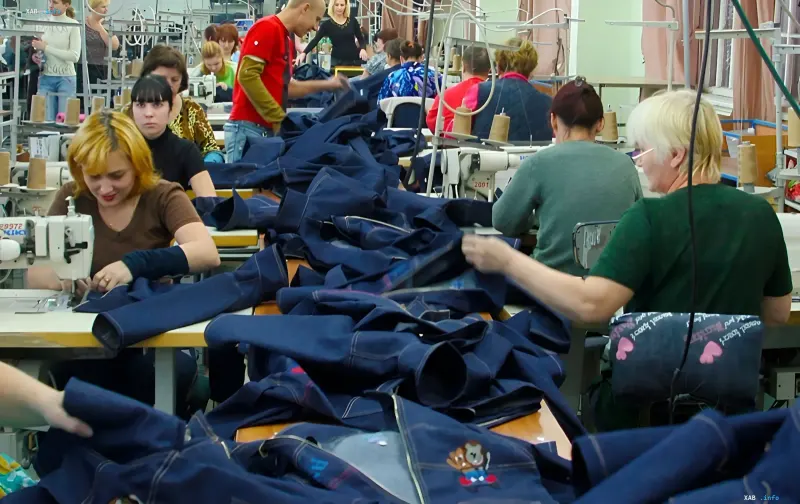
Gloria Jeans, one of the largest clothing manufacturers and retailers in Russia, invested approximately one billion dollars in its own sewing production facilities within the Russian Federation, only to be forced to abandon them, according to its founder and CEO Vladimir Melnikov. As reported by RBC-Ukraine citing The Moscow Times, the investments accumulated over 30 years, but after the start of the full-scale war in Ukraine, it became extremely difficult to keep the enterprises running. According to the company's assessment, it was precisely the sanctions pressure and its consequences that led to the capital put into Russian factories being effectively lost.
The Blow of Sanctions to the Production Base
Vladimir Melnikov explained that after sanctions were imposed on Russia, the company's access to the technologies and resources needed for sewing production sharply declined. "With our own efforts, we were unable to maintain production at the level of the 90s and early 2000s – we lacked both money and resources," he stated. Thus, even the long-accumulated production base could not be maintained at its previous level without external technological and material supplies, which, according to the head of the company, made continuing the operation of its own Russian factories economically unviable.
Rising Wages as an Additional Factor
The situation, according to The Moscow Times, was compounded by a sharp rise in wages in Russia in 2023–2025: they grew from $300–500 to $800–1500, while in Asian countries they remained at the level of $200–500. This gap in labor costs further undermined the competitiveness of Gloria Jeans' own Russian production and accelerated the decision to move output abroad, where labor is significantly cheaper.
Relocation of Production to Southeast Asia and Losses in Ukraine
After deciding to abandon its own factories in Russia, Gloria Jeans, according to Melnikov, had to "very quickly" relocate production to Southeast Asia. Separately, the company's head stated that due to the war he lost $200 million in investments in production in Ukraine, which, as reported by RBC and Mail.ru, were effectively "wiped out." Taken together, this makes Gloria Jeans one of the most telling examples of how sanctions policy and the military conflict are reshaping the geography and economics of major Russian civilian business.
Contradictory Data
The public wording contains a nuance in the assessment of losses. On the one hand, headlines and announcements speak of the company having "lost" about one billion dollars; on the other hand, Melnikov himself characterizes this amount as investments made over 30 years, into which he had to "abandon" further investment due to the inability to sustain production, rather than as a one-time loss over a single period. Moreover, the $1 billion invested in Russian factories and the $200 million lost in Ukraine are presented as two separate items. The exact breakdown between "frozen" capital, written-off assets, and actual monetary losses is not disclosed in open statements, so the final figure of total losses remains an estimate based on the words of the company's head himself.
Context: Civilian Business vs. the War Economy
The Gloria Jeans case fits into a broader trend: according to the Ukrainian Foreign Intelligence Service, civilian business in Russia is increasingly losing out to the war economy. Due to sanctions and the war, the civilian sector is forced to cut production and personnel, while state resources are being redirected in favor of the defense complex. Relocating sewing capacity to Southeast Asia becomes for the company a way to preserve its retail network, albeit at the cost of losing its own production sovereignty in Russia and Ukraine.