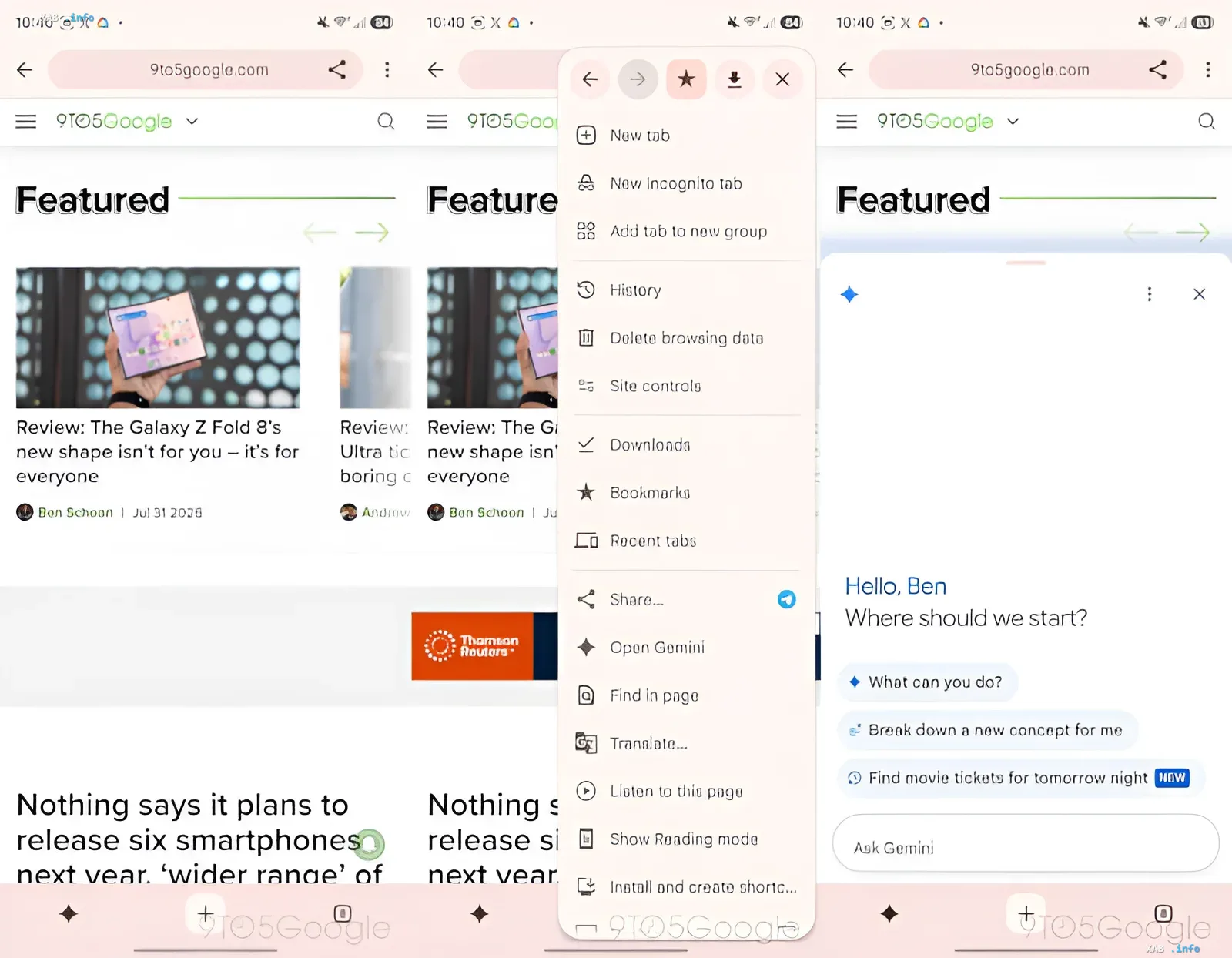
In August 2026, Google began rolling out a significant interface update for its mobile Chrome browser on the Android platform. As reported by sources including 9to5Google and Android Authority, the company is introducing a new navigation bar that radically changes the familiar user experience. The main novelty is the inclusion of a separate, dedicated button to launch the Gemini AI, signaling Google's desire to make the AI assistant an integral part of daily web navigation.
New interface architecture: navigation bar
The update affects the bottom of the screen, where control elements are traditionally located. In the new version, users will see a bar combining three key functions: creating a new tab, switching between open tabs, and launching Gemini. This solution aims to simplify access to the browser's main tools, freeing the user from the need to open the "three dots" menu for every action. The update is already available in the stable version of the browser, although the rollout (deployment process) currently covers a limited number of devices.
Adaptability and integration with the address bar
An interesting feature of the redesign is its adaptability depending on user settings. Previously, over a year ago, Google gave users the option to move the address bar to the bottom of the screen. Now, the new navigation bar interacts with this parameter: if the address bar is at the top, two control panels appear on the screen. If the address bar is moved to the bottom, the height of the bottom panel doubles to accommodate both the address and the new navigation buttons. This demonstrates Google's flexible approach to interface ergonomics.
Contradictory data
Although the current update is already available to users, the chronology of development and Google's promises contains inconsistencies. Back in May, the company announced the integration of Gemini into Chrome, promising to place the button on the same panel as the address bar and start deployment at the end of June. However, this did not happen. Instead of the expected solution in June, users received a completely different configuration in August — a separate navigation bar. Experiments with a similar interface began as early as July, indicating that the final design was adjusted during development, moving away from the initial plans announced in the spring.
Global scale of changes
It is worth noting that the changes are not limited exclusively to the Android ecosystem. According to sources, a similar solution was noticed in Chrome for iPhone, suggesting a possible unification of the Google browser interface across all mobile platforms. This underscores the strategic importance of Gemini for the company: access to it must be as simple and intuitive as possible, regardless of the device's operating system.