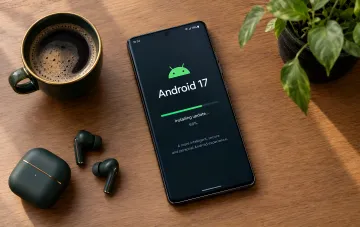
Google has begun accepting applications from third-party repositories for its Registered App Stores program. The innovation introduces a simplified process for installing and updating apps: once registered, users will no longer need to repeatedly confirm installation in extra system windows, and apps will be able to update in the background—just like it works in the Play Store. The simplified process will take effect on December 1 and will be available on devices running Android 17 QPR2 and later versions outside the US.
What Will Change for Users
The key difference between registered stores and current alternative catalogs is the absence of multiple system confirmations. Users will be able to install applications with a single tap, see download progress indicators, and receive automatic updates in the background. For stores that do not undergo registration, the installation and update procedure will remain the same: with the same system confirmation windows and no background updates. Thus, Google is effectively creating two operational tiers for alternative catalogs—an "advanced" one for registered stores and a standard one for everyone else.
How the Program Works and Who Qualifies
Participation in the program is voluntary: third-party repository administrators submit an application, and Google verifies compliance with requirements. According to the company, the program was announced in March as a way to "provide third-party repositories with a more convenient way to interact with users while maintaining the safety and security of the Android ecosystem." The implementation of the innovation is linked to the agreement reached between Google and Epic Games last year. In the US, the program will launch only after the court formally approves the Epic Games v. Google settlement.
What Registered Stores Will Get
In addition to simplified installation and background updates, program participants receive early access to documentation, support during the integration phase, and access to new tools, including the Android Developer ID API. This allows stores not only to distribute apps but also to verify developers, which increases user trust in alternative catalogs and brings their level of service closer to the official Play Store.
Payment and Content Control
Developers and store administrators are required to pay an annual registration fee, which covers access to new features and operational support. Google has also provided a quality control mechanism: if the amount of malicious content in a store's catalog exceeds a set threshold, an additional content review fee may be charged. Thus, the company ties expanded capabilities to financial responsibility and compliance with catalog security requirements.
Why This Matters: The Context of Alternative Catalogs
The expansion of third-party store rights occurs against the backdrop of the growing role of alternative catalogs in the Android ecosystem. Users are increasingly turning to them as an independent distribution channel, and certain large services already recommend installing and updating their applications through alternative stores. The Registered App Stores program makes such a channel technically comparable in convenience to the official one, altering the balance in the ecosystem: alternative catalogs receive tools that were previously the privilege of the Play Store, while remaining within the rules established by Google.