
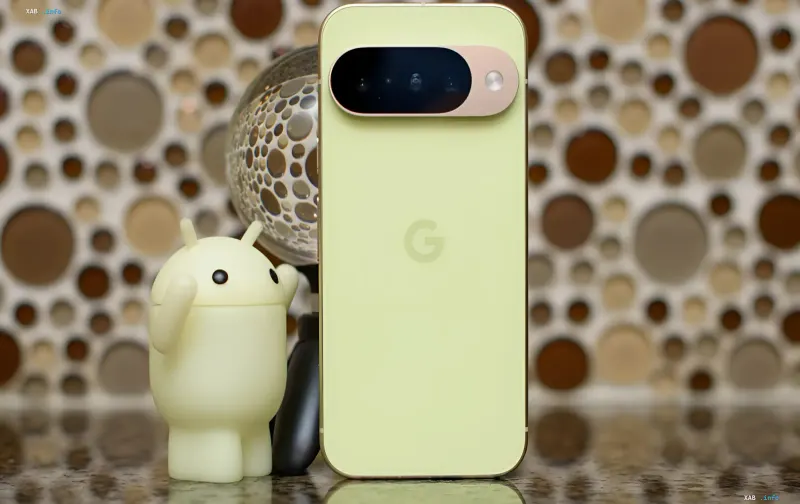
The new Google Pixel 11 smartphone series, built on the in-house Tensor G6 processor, has run into a serious problem: according to the latest benchmarks, the silicon platform clearly lags behind competitors' flagship chips. RBC-Ukraine reports this, citing Android Authority's analysis. The gap is especially noticeable in games and when running resource-intensive applications, while the Pixel 11 Pro's new AI features, in experts' assessment, do not yet make up for the shortfall in "raw" performance.
Graphics as the Achilles' heel
The series' weakest link remains the graphics processor. In a number of tests, competitors' flagship chips deliver roughly twice the peak graphics performance. According to reviews, the GPU stagnation is attributed to the use of more budget-friendly PowerVR DXT and CXT graphics solutions, which prevent the platform from scaling its power at the same pace as its rivals. As a result, the Pixel 11 already struggles with the most demanding modern games, casting doubt on Google's promised seven years of update support.
Thermal limits and throttling
A separate layer of problems is tied to how the GPU behaves under load. According to itc.ua, the Pixel 11 Pro's graphics processor loses up to 90% of its performance due to throttling at a temperature of around 36.7 °C. This means that even under normal operating conditions, when the device's body heats up during gaming or video recording, the actual graphics power can drop to critically low levels, directly affecting frame smoothness and stability.
The bet on AI and its price
In analysts' view, the main reason for today's compromises lies in the chip's architecture itself: Google is orienting the Tensor primarily toward the neural block (TPU) for artificial intelligence tasks. However, many of the new AI features, such as HiLight or Proactive Assistance, have not yet become indispensable for everyday use. At the same time, competitors — Qualcomm and MediaTek — integrate AI acceleration across the entire processor without sacrificing CPU and GPU power, giving them a more balanced performance profile.
Contradictory data
When comparing sources, discrepancies emerge over how final the cited figures actually are. Some materials (in particular, NotebookCheck) rely on "leaked" and preliminary Tensor G6 performance tests, while other outlets present the results as an established fact. Moreover, the magnitude of the GPU gap is described differently: some reviews speak of a twofold gap in peak graphics tests, others of a loss of up to 90% of power under thermal throttling at a temperature of around 36.7 °C. These metrics are not identical: the first characterizes peak architecture, the second — behavior under sustained load, so the conditions of a specific test must be taken into account when interpreting them.
What to do next
Experts advise Google not to repeat the mistake of simply enlarging the neural block in the next Tensor G7, but to distribute the processor's resources more evenly — in favor of graphics, cache memory, and power efficiency. Without such changes, the promised seven years of update support risks becoming a mere formality: even current games and applications may eventually stop running comfortably on hardware that, from the very start, trails its competitors in key scenarios.