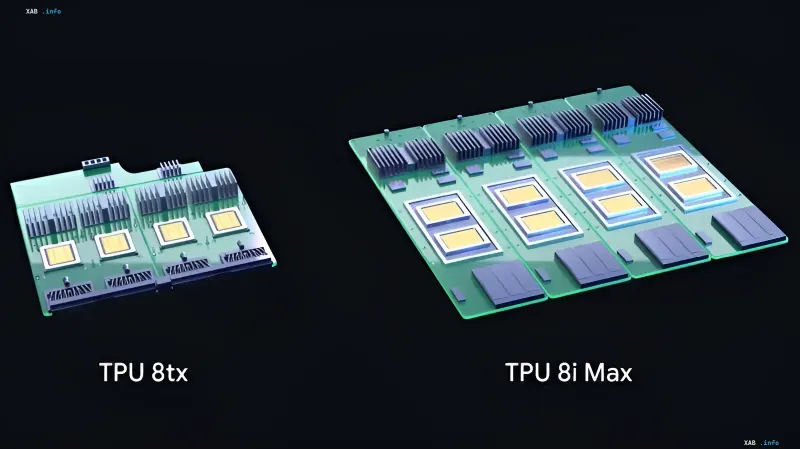
Google has expanded its eighth-generation Tensor Processing Unit (TPU) lineup by introducing two new systems: the TPU 8tx and TPU 8i Max. According to the company, both platforms are optimized for AI agent workloads, with security, high compute density, and improved inference capabilities prioritized during development. Together with the TPU 8t and TPU 8i announced earlier this year, the eighth-generation family now comprises four models, each tailored to a specific stage of the AI lifecycle.
From Chip to System: The Eighth-Generation Philosophy
The company emphasizes that it is introducing not just chips, but complete TPU-based systems. Developing a standalone chip is a multi-year process constrained by the laws of physics and lengthy manufacturing cycles, involving the placement of billions of microscopic transistors on a silicon wafer. A system, meanwhile, is a way to integrate computational power, networking resources, and storage around the chip—including their layout—allowing for a rapid response to new customer needs and research scenarios. Because AI software evolves faster than chip manufacturing technology, developers have focused on system balance and modularity, designing TPUs as "building blocks" for the AI Hypercomputer platform.
TPU 8tx: Hardware-Level Confidential Computing
The TPU 8tx system is built for secure and confidential inference operations, targeting government agencies and companies in strictly regulated industries that must handle the most sensitive data using advanced or proprietary models and autonomous agents. Security here is enforced at the hardware level: confidential data and model weights remain protected and isolated even during active processing. According to the source, the system combines the TPU 8t with fifth-generation AMD EPYC processors and hardware data protection. The introduction of the low-latency Boardfly network enables multi-step agents to operate efficiently, cutting latency in half compared to the TPU 8t with virtually no loss in performance. Teams can fine-tune models on their own private data, distill large models into compact versions, and train agents via reinforcement learning without moving sensitive data across clusters.
TPU 8i Max: Breaking the "Memory Wall"
The TPU 8i Max system is designed to handle massive context windows and deliver maximum compute density per server rack. Its key concept is breaking the so-called "memory wall": two TPU 8i chips are combined into a single module, scaling computing power and memory capacity synchronously. Compared to the base system, the TPU 8i Max offers twice the compute resources, twice the SRAM, and twice the HBM bandwidth. This is intended to assist in processing large contexts and enabling multiple agents to work concurrently on large-scale projects.
Context: How the Lineup Expanded
The first TPUs were developed by Google over a decade ago for internal company use. After eight generations, their application scope has expanded significantly: they are now used to train and run Gemini models, power AI agents, provide services to Google Cloud customers, and deploy directly in customer data centers. In April at Google Cloud Next, the company unveiled the generation's two foundational systems: the TPU 8t for large-scale training and the TPU 8i for real-time inference. According to Google, the TPU 8t delivers up to 2.7 times higher training performance compared to the previous generation, while the TPU 8i offers an 80% better price-to-performance ratio for inference. The TPU 8t maximizes "goodput"—the volume of effective computations per watt of energy—while the TPU 8i reduces inter-chip data exchange latency by up to 50%.
Ecosystem and Company Stance
Amin Vahdat, Google's Vice President and General Manager of Machine Learning, Systems, and Cloud AI, outlined the purpose of the four eighth-generation systems: the TPU 8t for large-scale model training, the TPU 8i for low-latency inference, the TPU 8tx for confidential computing, and the TPU 8i Max for massive context windows and maximum compute density in the rack. Alongside the new systems, Google also introduced supporting tools for working with the accelerators, notably the Agent Compute Engine, which pauses idle AI agent sessions and offloads their working memory from the accelerators so compute resources are not tied up while an agent awaits a tool or user response.