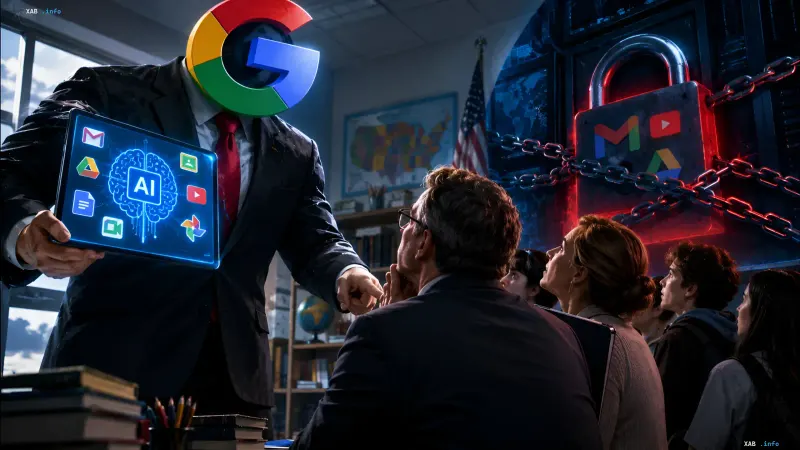
Google has announced a revision of the terms for its Workspace for Education platform, sparking a sharp reaction from American politicians and education experts. Starting in 2027, a number of services available to schools and educational institutions will be disabled by default for student accounts. According to goha.ru, this concerns the Gemini chatbot, Gemini tools in Classroom, and, most critically, the Google search engine for students. To continue using any of these services, a school administrator will have to manually activate them in the platform's settings.
What exactly is changing from 2027
The key change lies in the governance model: while previously Workspace for Education services were available to students by default, access will now be deactivated, and enabling them becomes a conscious administrative choice. Formally, Google emphasizes that it provides schools with "enhanced control over digital environment management." In practice, however, this means that every educational institution will be forced to decide which Google ecosystem tools it is willing to integrate into the educational process and which to leave disabled.
Why classic search has become a "hostage" to AI
The main problem, as pointed out by critics, is that Google has technically combined generative artificial intelligence features and classic search results into a single, indivisible block. This means that educational institutions that fundamentally oppose the use of AI in the educational process—partly due to studies indicating a risk of reduced cognitive skills and analytical thinking among students—will be unable to maintain access to regular Google search without simultaneously enabling Gemini tools. Thus, refusing AI effectively turns into refusing search, which, according to experts, deprives schools of one of the basic tools for student research work.
Regulator reaction and Google's position
The first to speak out publicly was Rohit Chopra, Director of the Consumer Financial Protection Bureau and representative of California's economic development, who accused the tech corporation of pressuring schools. According to him, linking the basic search service with AI tools forces educational institutions to choose between two options: either integrate generative AI into the learning process or lose access to search. In response, Google management stated that modern search algorithms and generative functions are deeply integrated into a single ecosystem, and separate functioning of the services is technically impossible. The corporation insists that schools receive not a restriction, but an additional layer of control over the digital environment in which students operate.
Context: Structural dependence of schools on the Google ecosystem
An analysis of the situation shows that the dispute over Workspace for Education goes far beyond a single product decision. Millions of American schools have used Gmail, Drive, Classroom, and Google Search as the infrastructural foundation of the educational process for many years. Switching to alternative platforms requires significant costs for data migration, retraining staff, and restructuring work processes. In conditions where Google effectively monopolizes the educational segment through a free service model, any change in terms of use takes on a character that critics describe as a "choice under pressure." Education policy experts note that this practice sets a precedent where a tech company can use the infrastructural dependence of clients as a tool to promote new product solutions.
At the time of writing, Google had not specified whether the company is considering the possibility of separating search and AI functionality at the request of regulators. States that already have restrictions on the use of generative AI in schools are continuing to monitor the situation. It is expected that the issue will be brought up for discussion at the level of federal legislators in the coming months.