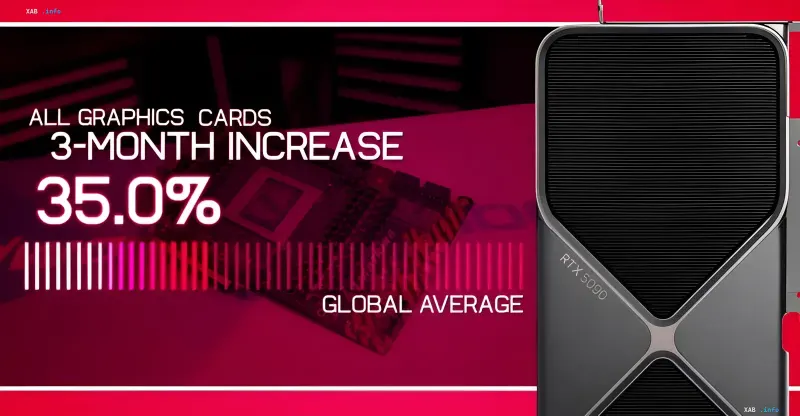
Retail prices for graphics cards continue their steady upward climb: according to an October study by the YouTube channel Hardware Unboxed, the cost of graphics accelerators has increased for the third consecutive month. On average across the market, the markup over the past three months has reached approximately 35%, with October's monthly growth hitting about 10% (excluding the flagship GeForce RTX 5090) and roughly 11% including it. Analysts emphasize that there is no 'light at the end of the tunnel' yet, and prices within the current generation are unlikely to return to launch levels.
Monthly Dynamics and Measurement Methodology
The October increase follows a 15% jump in August and a 7% growth in September. The cumulative effect of these three months accounts for the total 35% increase over autumn prices. The study covers ten countries, including the US, Germany, Great Britain, Canada, Australia, and Poland. Crucially, Hardware Unboxed tracks not the average price of all custom variants, but the cost of the cheapest models actually available in stock. This approach allows for a fair comparison of minimum available prices across different markets without distorting the picture with rare, expensive modifications.
Nvidia Flagships at the Center of the Price Storm
The highest monthly increase was recorded among Nvidia's top-tier models. The GeForce RTX 5090 went up in price by an average of 32%: in the US, the most affordable version now costs $9,400 compared to $6,890 in September, in Germany the price rose from 5,640 to 8,000 euros, and in Poland it reached 38,000 zlotys. The GeForce RTX 5080 also saw a significant price hike — averaging 22% for the month. In the US, the minimum price increased from $1,580 to $2,200 (+39%), while in Germany the model reached 2,100 euros (+40%). The study's authors specifically noted limited availability of the RTX 5080 across several retail networks, which further fuels price pressure.
AMD and Intel Also on the Rise
The trend is not limited to Nvidia products. In the AMD segment, the 16GB Radeon RX 9060 XT rose globally by 17%, while the RX 9070 and RX 9070 XT increased by 12%. The cost of the Intel Arc B580 grew by approximately 10%, though figures vary by country. Notably, in October, Radeon graphics card prices grew even faster than GeForce models, excluding the anomalously inflated RTX 5090. Price increases affected the majority of models across all three vendors.
Markup Over MSRP and Geography
According to Hardware Unboxed estimates, current retail prices exceed manufacturer's suggested retail prices (MSRP) at launch by an average of 44%, excluding the RTX 5090. Calculations factored in currency exchange rate adjustments and local taxes relative to initial US prices. The highest markups were recorded in Canada (58.3%) and the US (57.6%), while the figure stands at 45.3% in Germany and 43.1% in Poland. This indicates that the gap between the 'factory' price and actual retail has become systemic rather than a local phenomenon.
Forecast and Consumer Behavior
The authors of Hardware Unboxed stated outright that prices for graphics cards are unlikely to normalize within the current generation. This conclusion aligns with demand data: according to Jon Peddie Research, shipments of discrete 3D cards last quarter reached a multi-year record of 12.5 million units, the highest since Q1 2022 (+5.9% quarter-on-quarter and +7.8% year-on-year). Analysts attribute this surge in purchases to consumers rushing to buy cards before the next round of price hikes. In the market, Nvidia maintains around 90% share, AMD rose from 6% to 8%, and Intel holds roughly 2%.