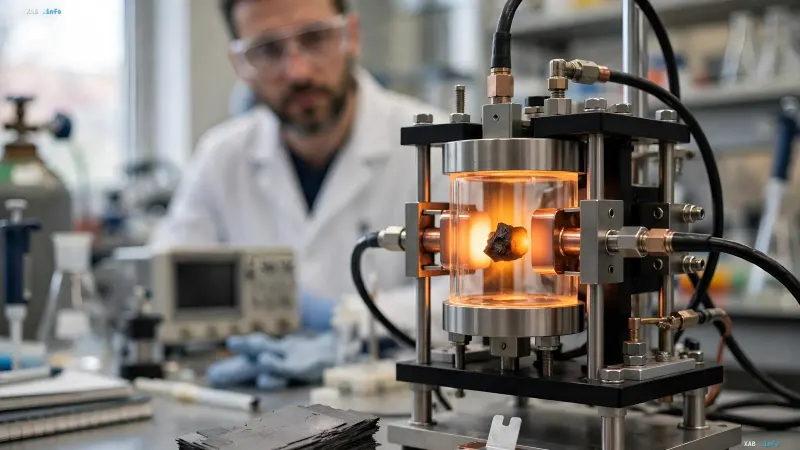
The main bottleneck in rapid lithium-ion battery charging remains the graphite anode. It is through its layered structure that lithium ions must penetrate during energy replenishment, and the speed of this process effectively dictates the full charging time. Researchers at Rice University (USA) proposed not accelerating the process itself, but changing the graphite structure at the production stage so that it is easier for ions to enter the material. To achieve this, the team uses a nickel catalyst and a short, powerful electrical pulse, turning raw material into ordered graphite in fractions of a second.
A Pulse Instead of Multi-Day Heating
The starting material is petroleum coke, a carbon-rich petroleum refining byproduct. A small amount of a nickel compound is added to it, after which an electrical pulse is passed through the mixture. As a result, the material instantly heats up to nearly 2,500 °C, and the carbon rearranges into ordered graphite in just 0.2 seconds. By comparison, the classical method of producing synthetic graphite requires prolonged high-temperature exposure, making the process energy-intensive and slow.
Nickel as a “Builder” Rather Than a Component
The key role of nickel is to help carbon atoms align into ordered layers. In doing so, the distance between layers increases slightly, making it easier for lithium ions to penetrate inside the anode. Importantly, the improved properties do not depend on the metal's presence in the final material: the team removed over 99% of the residual nickel, yet the structural advantages of the graphite remained. Thus, nickel acts as a temporary catalyst for structure formation rather than a permanent anode element.
What the Tests Showed
In a laboratory battery, the new material demonstrated a reversible specific capacity of 347.4 mAh/g at a charging rate of 0.25C. With a sharp acceleration to 15C, the capacity reached 158.8 mAh/g—a figure corresponding to theoretical charging in four minutes at a nominal battery capacity. After 1,000 charge and discharge cycles, the battery retained 80% of its initial capacity. Combined, these characteristics allowed the new graphite to outperform both conventional commercial material and graphite produced via pulse heating without a nickel catalyst.
Production Benefits and Savings
Beyond anode characteristics, the technology provides a production advantage. According to the authors' calculations, the new method reduces energy consumption and greenhouse gas emissions during graphite production by more than 80%. The production cost of synthetic graphite for fast charging, according to the published paper, can drop by up to 80%—to roughly $0.84 per kilogram. This makes the method potentially competitive not only in speed, but also in economics and environmental friendliness.
Limitations and Next Steps
At the same time, it is important to consider the technology's development stage. The team demonstrated the material's properties in a laboratory battery, not in a serial electric vehicle battery. Four-minute charging remains a benchmark that must be verified when scaling up the process and creating full-sized battery packs. The next step will be the transition from laboratory samples to industrial lines and the integration of the new graphite into real traction batteries.