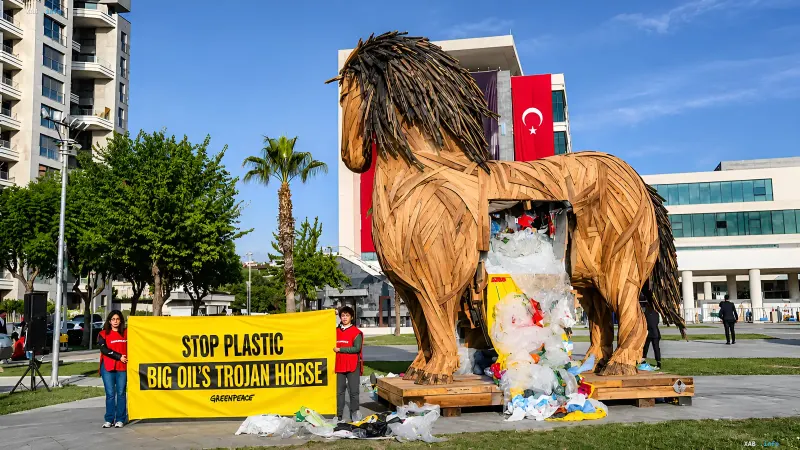
Amidst preparations for the COP31 summit in Antalya, a massive installation has appeared outside the Konyaalti district town hall in Turkey: a six-meter-tall wooden "Trojan Horse," with a heap of plastic waste spilling continuously from its belly. Greenpeace activists, waving yellow banners reading "STOP PLASTIC — BIG OIL'S TROJAN HORSE," accompanied the unveiling of the structure, while passersby stopped to film the scene. Nearby, municipal cleaning services were cleaning the adjacent coastline of litter at the same moment, providing a striking visual contrast to the demonstration.
An allegory created with a Danish artist
The sculpture was executed in collaboration with Danish artist Thomas Dambo, known for his large-scale wooden structures. According to the creators, the horse is not just a nod to the myth of the Trojan War, but a direct metaphor: plastic, like the legendary gift to the Trojans, slips unnoticed into everyday life, only to "release" a hidden environmental cost. The installation aims to draw attention to fossil fuel companies that continue to ramp up polymer production despite the rising volume of plastic pollution in oceans and coastal zones.
'Plastic is the petrochemical industry's Trojan Horse'
Greenpeace activist Berk Butan, speaking by the structure, emphasized that the sculpture clearly demonstrates how plastic functions as a "Trojan Horse" for the petrochemical industry—seeping imperceptibly into consumer routines and then turning into waste that society cannot manage. According to the activists, the exhibition is designed not only for the local audience but also for world leaders gathered in Antalya for COP31: the goal is to prompt them to make decisions on reducing primary plastic production and tightening waste management systems.
Reaction of local authorities
During the opening ceremony, the Mayor of Konyaalti, Cem Kotan, stated that the installation conveys a "resonant call" to both high-ranking guests gathered in Antalya and viewers around the world. According to him, the appearance of such artistic protest at a turning point in international climate negotiations and industrial regulation underscores the urgent need to curb waste streams associated with fossil fuel use. Thus, the city authorities publicly supported the activists' message without questioning the summit's environmental agenda.
Context: COP31 and the global plastic agenda
The COP31 summit is taking place in an environment where climate negotiations are becoming increasingly intertwined with issues of industrial regulation and the circular economy. Plastic pollution remains one of the most visible and emotionally charged topics for environmental movements: unlike abstract CO₂ emission figures, piles of plastic on the coast are visible to everyone. The installation in Konyaalti, which coincided with the work of climate delegations, became another example of how street art and activism attempt to translate the environmental agenda from reports and resolutions into a public visual statement addressed to both politicians and the public.