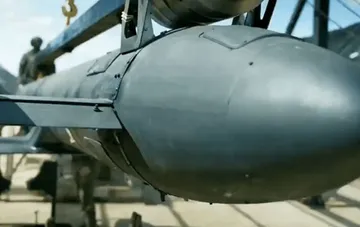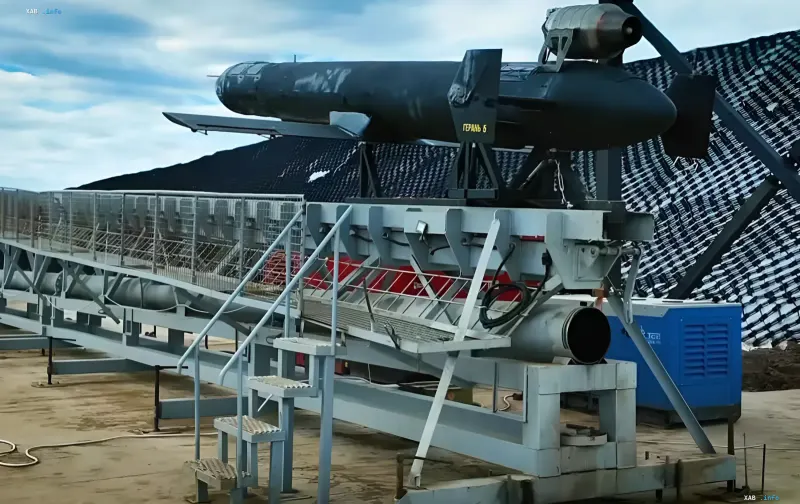
The Main Directorate of Intelligence of the Ministry of Defense of Ukraine has published the results of an analysis of a new modification of the Russian jet-powered drone "Geran-5," designated as K5-K. According to the GUR, Russian military forces began using this variant for strikes against Ukrainian cities in early autumn 2026. Agency experts classify the K5-K, based on its aerodynamic layout and technical specifications, as a compact cruise missile, which distinguishes it from previous versions of the "Geran-5" and brings it closer to the class of guided missile weaponry.
Aerodynamic Layout and Reduced Dimensions
The K5-K airframe, like its predecessor, is built with a standard aerodynamic layout: a straight-tapered wing is positioned as a high-wing configuration, with a single-fin tail assembly featuring fixed stabilizers and a rudder. However, this new modification is shorter than the standard "Geran-5" in both length and wingspan. In Russia, according to GUR assessments, work was carried out to improve the aerodynamic characteristics of the fuselage to increase the vehicle's speed and altitude performance.
Speed and Altitude Capabilities
The service ceiling of the K5-K has been increased from 5 to 6 km. The cruising speed has risen to over 450 km/h, and in certain maneuvers, it can reach a maximum of 1000 km/h. Flight range and warhead weight remain unchanged—1000 km and 90 kg, respectively. According to intelligence data, the analyzed sample is equipped with a TBBCh-90 thermobaric warhead.
Avionics and 'Susanin' Guidance System
The avionics of the K5-K, according to the GUR, are identical to the latest versions of the "Geran-4 Seeker" jet UAV: a flight controller, the "SADRA seeker" inertial navigation system with a "MOKH" module, a localized copy of a 16-element Harxon GI-006 CRP antenna, a tracker, and a mesh module. Special attention is drawn to the new "Susanin" optoelectronic correlation system, previously discovered in the "Geran-4." The system compares the image from an optical sensor with a reference image loaded into the microcomputer's memory to ensure the flight path matches from the launch point to the target point. In the analyzed K5, a dual-band camera was used as the optical sensor, and the information processing unit consists of a Coke Pi microcomputer in a plastic housing with corresponding markings.
Propulsion and Component Origins
The K5-K is powered by a TRD-200 turbojet engine, assembled in Alabuga using Chinese components. According to the analysis, out of 93 electronic components, the largest share consists of parts from manufacturers in the USA, China, and Switzerland, which indicates the dependence of Russian jet-powered avionics on foreign imports.
Context of Use and Air Defense Effectiveness
As the GUR notes, Russian jet drones are capable of reaching even the western regions of Ukraine, and their flight range is determined by technical specifications, fuel reserves, and onboard equipment. At the same time, the Ukrainian air defense system is gradually improving the interception efficiency of such vehicles: currently, the average destruction rate for "Geran-4" type drones is approximately 60%.