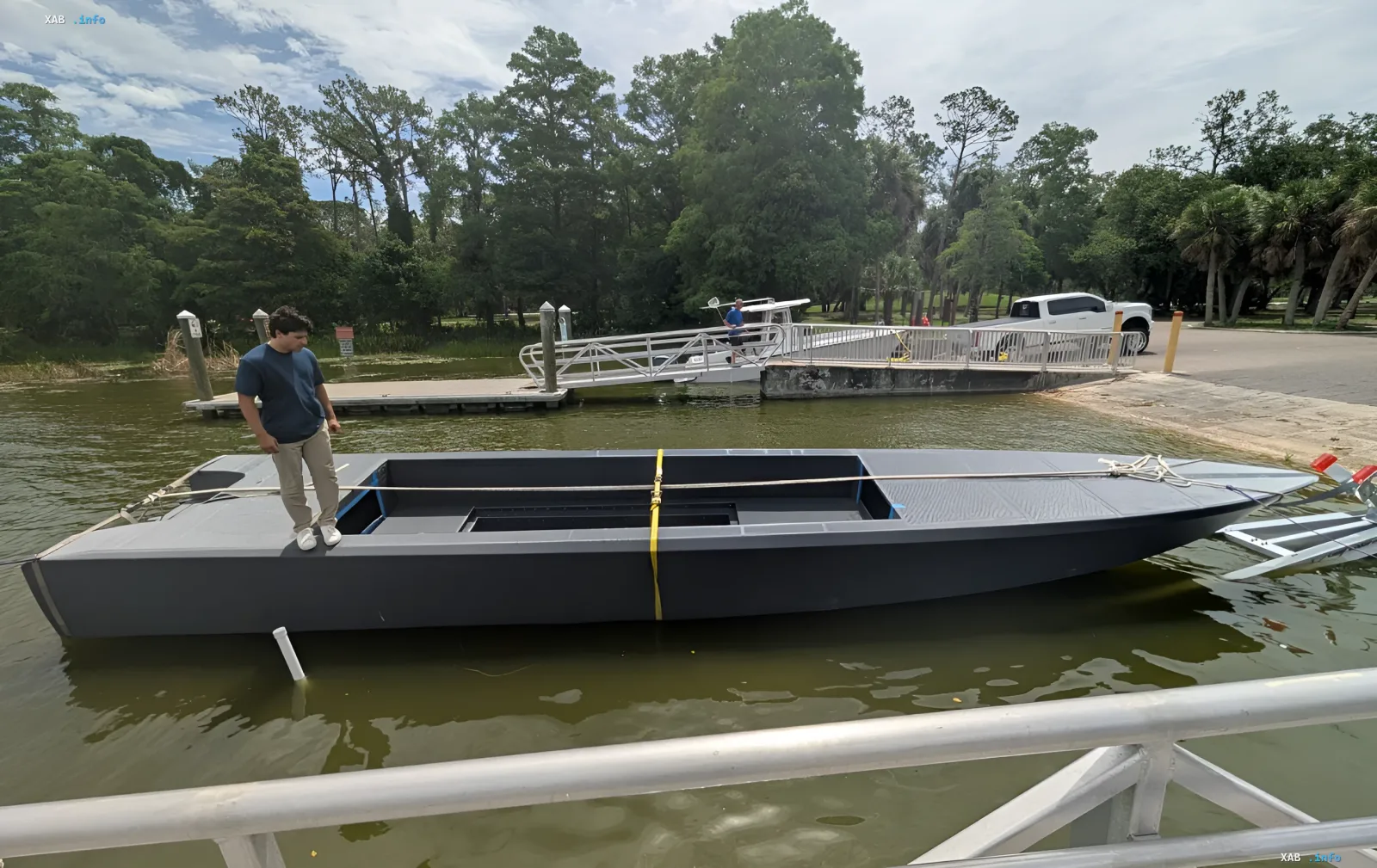
Amidst the rapid militarization of maritime theaters and the growing demand for autonomous systems, the American company Haddy has unveiled a new unprecedented project — the TF-179 unmanned naval boat. The uniqueness of this vessel lies not so much in its tactical and technical characteristics as in its production method. The vessel was manufactured using large-format robotic 3D printing technology, opening new horizons for shipbuilding.
Revolution in shipbuilding: from concept to water in a matter of days
According to the company's press service, the TF-179 became possible thanks to the implementation of innovative additive manufacturing methods. Unlike traditional shipyards, where the hull creation process can take months, Haddy's technology allows the development cycle to be reduced to a minimum. According to engineers, digital production ensures unprecedented flexibility: from changing blueprints to the final launch into the water, the time taken is minimal.
"As the demand for specialized maritime platforms grows, production methods must evolve alongside them. The ability to quickly produce, evaluate, and refine complex systems is becoming an increasingly important advantage," the company noted. This is particularly relevant in 2026, when the speed of asset deployment often determines the success of an operation.
Secrets of the TF-179 and production facilities in Florida
Despite the demonstration of a finished prototype, Haddy keeps the key characteristics of the TF-179 under strict secrecy, including its payload capacity, range, and the type of weaponry or payload used. The final customer for the vessel is also unknown, sparking speculation within the military-industrial community. However, it is known that the production facilities where the hull was printed are located in St. Petersburg, Florida.
Visually, the boat is a low-profile vessel with a flat bottom and an open cargo hold, allowing it to be flexibly adapted for various tasks: from reconnaissance to cargo transport or weapon installation.
Parallels with Ukrainian developments: the evolution of the naval drone
The appearance of the TF-179 against the backdrop of active hostilities in the Black Sea cannot help but evoke associations with Ukrainian developments. Previously, the Main Directorate of Intelligence (GUR) of Ukraine reported work on a new system for maritime drones capable not only of destroying targets but also of detaining sanctioned vessels.
According to the commander of a GUR unit with the callsign "Ninth," the basis of the new concept is the upgraded multi-purpose "Katran" drone. While Ukraine focuses on upgrading existing platforms for specific combat tasks, Haddy's American approach offers the creation of entirely new hulls from scratch, which could become the next stage in the evolution of naval drones.
Contradictory data
There are discrepancies in open sources regarding the status of the TF-179. On the one hand, Haddy positions the vessel as a ready-made product, demonstrating it on the water. On the other hand, the lack of official technical specifications and information about the customer suggests that the TF-179 may be in the experimental design stage (R&D) or be a demonstration prototype to attract investors. Furthermore, there is no confirmed data on whether this technology is currently used by active combat units of the US or its allies.
The future of additive shipbuilding
The TF-179 project demonstrates how 3D printing technologies are changing the landscape of the defense industry. The ability to quickly print ship hulls allows for an operational response to changes in enemy tactics and the scaling of production if necessary. In 2026, when speed and adaptability become key factors, such solutions could become the standard for creating unmanned maritime systems.