
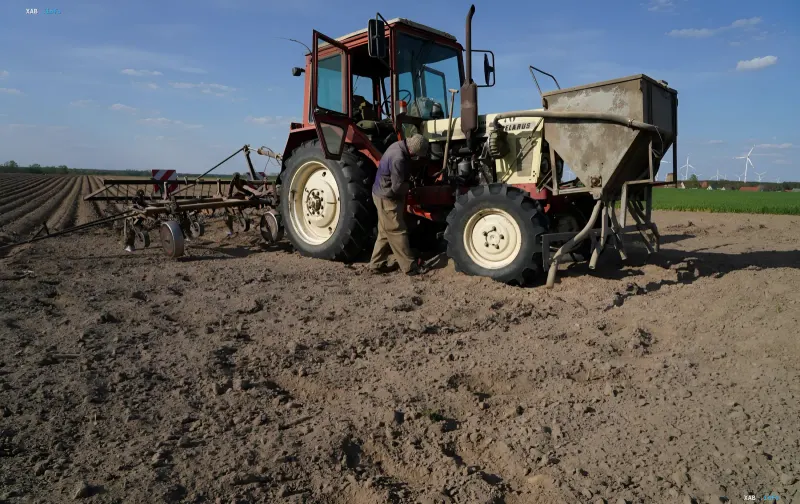
The end of August 2026 became a period of sharp weather contrasts for Ukrainian agriculture, with direct consequences for the condition of late-maturing crops and preparations for the autumn sowing campaign. According to the press service of the Ukrainian Hydrometeorological Center, published on Facebook and reported by RBC-Ukraine, the third decade of August was marked by a typical but anomalously hot summer with extremely uneven precipitation distribution. These factors, according to specialists, created heterogeneous agrometeorological conditions that had an unequal impact on agricultural crops in different regions of the country.
Temperature anomalies: from +7°C above normal to "nearly normal" days
UkrHMCS specialists recorded that the average daily air temperature in the third decade of August 2026 exceeded the climatic norm by 5–7°C. At the same time, the agency clarified that "on the remaining days, the daily temperature readings were close to the norm." With the passage of an atmospheric front, rainfalls of varying intensity were observed in some regions, locally reaching the threshold of a dangerous meteorological phenomenon of hazard level I — when a third of the monthly precipitation norm fell within just a few hours. However, in most regions the total precipitation was significantly below the long-term average.
Moisture deficit: the soil received no "effective" rainfall
The key problem of the third decade of August was the lack of moisture accumulation in the soil. As UkrHMCS experts emphasized, "during the decade, replenishment of soil moisture reserves did not occur due to the absence of effective precipitation." Local rainfalls recorded in certain areas "had no significant effect on soil moisture." This means that the maturation of late-maturing agricultural crops took place under conditions of a progressing soil moisture deficit, creating risks for yield formation and product quality.
Regional spread: west and north in the lead, the rest of the country behind
The agrometeorological situation in Ukraine during the period in question was extremely heterogeneous. In most western and northern regions, conditions were assessed as "quite satisfactory" thanks to adequate soil moisture. In the central, eastern and southern regions, by contrast, the moisture deficit became the dominant factor. The greatest threat from the lack of moisture accumulation is posed to the sowing of winter rapeseed, whose optimal sowing period falls within the coming period: without a sufficient reserve of soil moisture, germination and crop development will be significantly limited.
Contradictory data
The UkrHMCS publication contains an internal inconsistency in the presentation of temperature data: on the one hand, it is stated that the average daily temperature for the decade was 5–7°C above the norm, while on the other hand it is noted that "on the remaining days" the readings were close to the norm. If the average over a ten-day period exceeds the norm by 5–7°C, then for mathematical consistency a significant portion of the days would have to be substantially hotter than average, rather than "close to the norm." Perhaps the 5–7°C above the norm refers to a characteristic of peak days rather than the decade's average value, however this distinction is not made in the press service's text. Readers should take both versions into account when interpreting the scale of the anomaly.
Economic consequences: from rapeseed to potatoes
The weather conditions at the end of August 2026 are already beginning to be reflected in price expectations on the agricultural market. Previously, Nikolai Furdyga, Director of the Institute of Potato Growing of the National Academy of Agrarian Sciences of Ukraine, explained why potato prices could "soar" during the winter period, linking this to the current year's harvest damaged by the heat. Meanwhile, orchard growers are discussing the price prospects for apples in the new season. Thus, the temperature swings and moisture deficit of the third decade of August 2026 are forming an additional pressure factor on the cost of basic food products in the coming months.