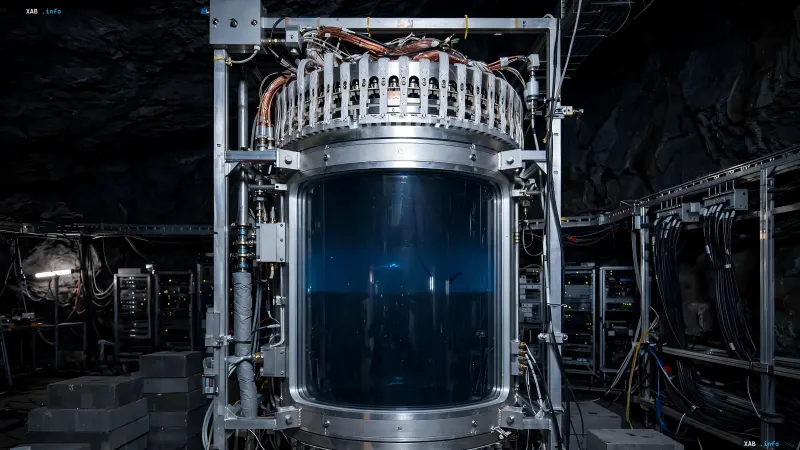
A group of physicists has proposed an extended model in which dark matter could consist of higgsinos — hypothetical particles associated with the Higgs boson within supersymmetry theories. The key goal of the work is to explain an unusual event recorded by the LUX-ZEPLIN (LZ) experiment: a xenon nucleus recoil with an energy of 248 keV that does not fit standard background interpretations. The authors tested their calculations not only against LZ data but also taking into account constraints from the IceCube observatory, which has detected no expected neutrinos from potential dark matter particle annihilation inside the Sun. Thus, the model claims compatibility with two independent experimental constraints simultaneously.
Mechanism: Transition Between Two Neutral States
In the proposed model, higgsinos are represented by two neutral states with a small mass difference. Upon collision with a xenon nucleus, the lighter particle can transition into the heavy state, transferring significant energy to the nucleus. Exactly such a mechanism can produce a rare high-energy recoil similar to the LZ event. The authors' calculations show that suitable model variants have a mass difference of approximately 350–525 keV. The result depends on the higgsino mass and the assumed velocity distribution of dark matter in the vicinity of the Solar System. In particular, the authors accounted for the influence of the Large Magellanic Cloud: its gravity can increase the fraction of especially fast particles in the vicinity of the Milky Way. This is essential for the model, as collisions with xenon nuclei capable of exciting the heavier higgsino state require a high particle velocity.
Mass Range: From 1.1 TeV to Hundreds of TeV
The lightest variant — a higgsino with a mass of about 1.1 TeV, which could have been produced in the early Universe in an amount corresponding to the observed dark matter density — turned out to be only at the edge of compatibility with LZ and IceCube data. Heavier variants look more convincing: under certain assumptions, the calculations allow masses from roughly 2 TeV to hundreds of TeV and higher. For example, the variant with a mass of about 2 TeV remains compatible with both experiments when accounting for the influence of the Large Magellanic Cloud and without an additional constraint based on the absence of events in the higher-energy range of LZ.
Model Limitations and Experimental Uncertainty
The authors emphasize that the proposed construction does not mean a reliable discovery of dark matter particles. The conclusions depend on parameters that are still not measured with sufficient precision: the velocity distribution of the particles, their interaction with matter inside the Sun, and the efficiency of cooling after capture by solar gravity. There is also experimental uncertainty: LZ has not yet published the calibration of the nuclear recoil registration efficiency in the additional high-energy range. Furthermore, IceCube's constraints for masses above 10 TeV have to be estimated in the work by extrapolation, which reduces the reliability of the corresponding conclusions.
How to Test the Model
The proposed model can be tested in several directions. First, new data on high-energy nuclear recoils from LZ and similar experiments will clarify whether there is a statistically significant excess of events in the relevant range. Second, more accurate calculations of solar capture of dark matter particles and their interaction with matter inside the Sun will narrow the uncertainty in IceCube's constraints. Third, independent searches for dark matter traces — in accelerator experiments, astrophysical observations, and other underground detectors — will provide additional verification. Meanwhile, the model remains a theoretical construct that explains the anomalous LZ signal without contradicting IceCube data, but requires further experimental verification.