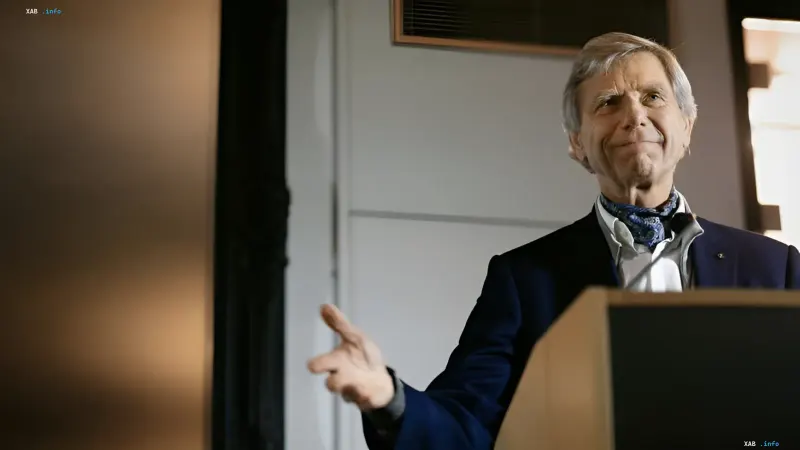
Amid the rapid development of artificial intelligence, which many experts believe is driving a new economic era, legendary venture investor and co-founder of the Arm architecture, Hermann Hauser, calls for caution. In an interview with CNBC published in August 2026, Hauser described AI as a "technological revolution capable of creating more economic value than any previous breakthrough." However, acknowledging the scale of change, he warned that the market is currently moving on a "roller coaster" trajectory, where euphoria will inevitably be followed by a correction.
Market Correction and the Trap of Circular Financing
One of the main dangers, according to Hauser, is inflated market valuations. He pointed to the emergence of specific circular financing schemes that could trigger a crash. In these schemes, a chip manufacturer invests in an AI startup, which in turn purchases accelerators from the supplier, artificially inflating the capitalization of both parties. Hauser believes that such valuations have "gone too far" and will not withstand the test of reality.
Nevertheless, the investor does not predict a catastrophic scenario similar to the 2008 financial crisis. According to him, the largest players in the AI market possess significant capital reserves, which will allow them to survive the period of cooling expectations. Hauser draws a clear line between technological progress and market speculation: AI development is a real structural change, while current stock prices may prove unstable.
Architectural Shift: From Electronics to Photonics
Beyond financial speculation, Hauser sees a fundamental shift in computer architecture itself. The growth in computational load hits physical limitations: chips require huge amounts of energy, are difficult to cool, and memory access remains a bottleneck. The solution to these problems, according to the expert, will be in-memory computing and photonic technologies.
In-memory computing implies performing arithmetic operations directly next to the data, eliminating the need to constantly move information between the processor and memory. The second direction—photonics—is already attracting colossal investments. In particular, Nvidia has directed $6.5 billion in the last three months to companies working on replacing copper connections with light channels inside data centers. Hauser compares the significance of these changes to how the Arm architecture once allowed less energy-efficient processors to be displaced.
Europe: The Risk of Becoming a "Technological Colony"
Hermann Hauser paid special attention to the situation in Europe. He acknowledges that European companies have qualified personnel and technologies capable of competing with the US and China. However, in his opinion, the continent is failing at the next stage—scaling successful startups into global corporations. This creates a threat to technological sovereignty: Europe remains dependent on foreign suppliers not only for AI models but also for critical software for chip design.
Hauser does not call for severing ties with the US, but warns of the fine line between cooperation and dependence. His formula is simple: maintain the partnership but do not become a "technological colony." In the context of geopolitical tensions and export restrictions, this position is becoming increasingly relevant. In June, the European Commission began responding to these challenges by proposing a package of measures for technological sovereignty, including restrictions on the use of American cloud providers for government data and the preparation of Chips Act 2.0.
Contradictory Data
There are discrepancies in assessing the prospects of the AI market between the optimistic forecasts of tech giants and the cautious warnings of investors. Large corporations, such as Nvidia, demonstrate aggressive expansion and invest billions in new technologies (photonics), signaling a belief in long-term growth. At the same time, industry veterans like Hermann Hauser point to signs of market overheating and bubbles created by circular financing schemes. While the market is in a phase of active growth, these contradictions remain hidden, but as Hauser notes, it is the correction phase that will reveal which players possess real value and which are merely speculative.