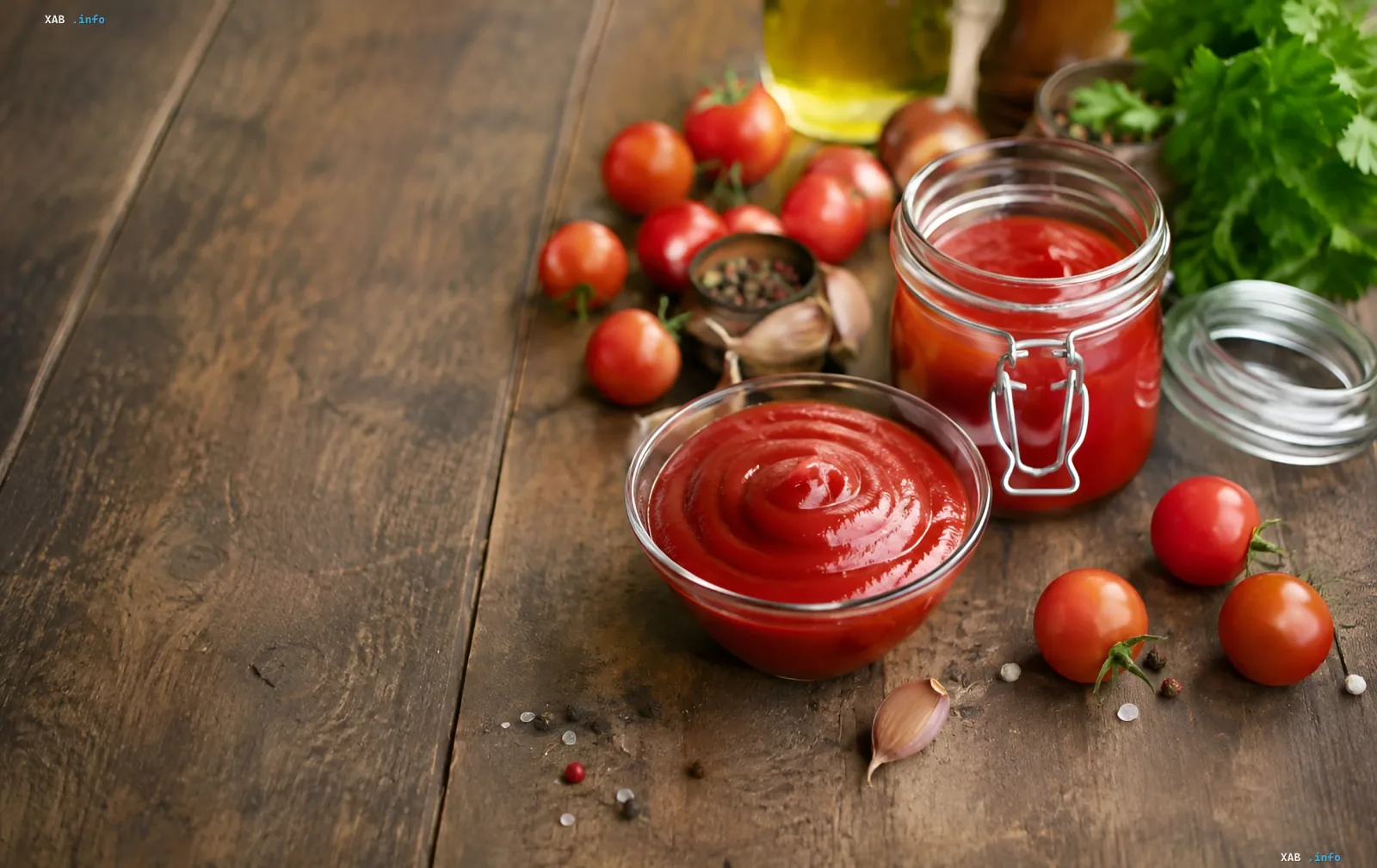
The distinctive sweet ketchup from fast food can quite realistically be recreated in a home kitchen. According to Styler (an RBC-Ukraine project), no rare ingredients are needed for this: the recipe's base is simple, and all the ingredients can easily be found in an ordinary store. The article draws on the advice of Instagram food blogger mamanata.food, as well as on the approach of American chef Billy Parisi, who shares his own version of a homemade sauce.
Base and Key Ingredients
The main secret behind the sweetness characteristic of fast-food ketchup lies in the large amount of sugar. The base is tomato juice or crushed tomatoes, which are poured into a large pot and placed over medium heat. Once boiling, the heat is reduced and the mixture is cooked, stirring occasionally. Then sugar, salt, and black pepper are added, stirred thoroughly until the sugar dissolves and the spices are evenly distributed, after which vinegar is poured in — its amount is adjusted to taste to strike a balance between sweetness and tang.
Preparation Technique According to mamanata.food
Once the tomato mixture has reduced somewhat, a thickener is prepared: starch is mixed with a small amount of cold water until smooth and poured into the hot sauce in a thin stream, stirring constantly. The ketchup is cooked for a few more minutes until thick, then cooled and stored in the refrigerator. It is the starch in this version that gives the sauce its dense, "fast-food" texture.
Chef Billy Parisi's Approach
American chef Billy Parisi offers a different path. He advises not to caramelize the onion and garlic, but merely to soften them, after which tomato puree, tomato paste, vinegar, sugar, and spices are added. He recommends cooking the sauce over low heat for 40–45 minutes, then passing it through a fine sieve — in his expert opinion, it is precisely this step that gives the ketchup a smooth, uniform consistency without starch thickening.
Contradictory Data
The two presented versions differ noticeably in technique and time frames, which is important to keep in mind when recreating the recipe. Food blogger mamanata.food relies on starch as a thickener and a relatively short cooking time after it is added, whereas Billy Parisi dispenses with starch, relying on a long simmer over low heat for 40–45 minutes followed by straining through a sieve. Parisi's recipe also explicitly features onion and garlic (softened, not caramelized), which are not mentioned in the blogger's base version. Both viewpoints are legitimate: the choice between them depends on the desired texture — thicker and denser (starch) or smoother and more strained (sieve).
In both versions, the finished homemade ketchup is cooled and stored in the refrigerator. The material is of an entertaining, lifestyle nature and was published by the Styler project (RBC-Ukraine); the illustration for the article was generated by artificial intelligence and is not a photograph of a real dish.