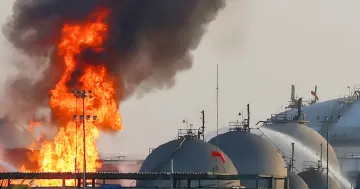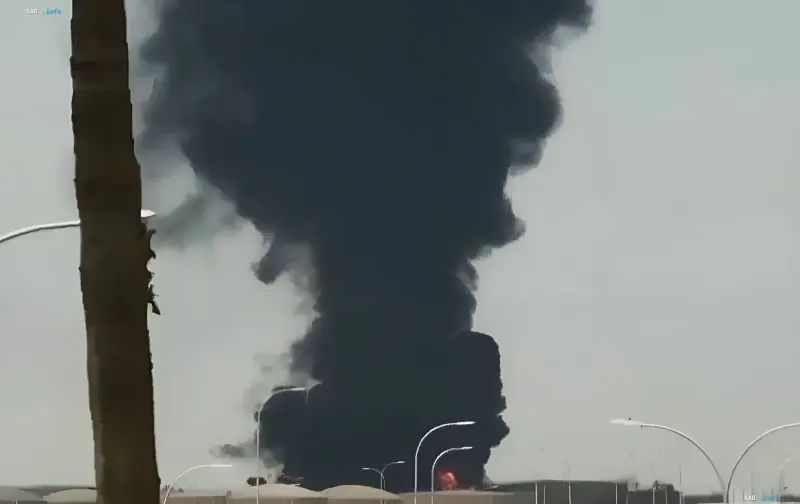
On the night of September 20, 2026, Yemeni Houthis announced that they had carried out missile and drone strikes on "sensitive" targets in Riyadh, the capital of Saudi Arabia. Before the group claimed responsibility, witnesses near the city's main airport recorded flames and a thick column of black smoke. According to available observations, the fire, most likely, rose from fuel storage tanks located in the immediate vicinity of the terminal. Even before any signs of fire appeared, Saudi authorities had been sending warnings to the population about a possible danger in the Riyadh area during the night hours, against the backdrop of escalating Houthi attacks.
Strike on Oil Exports: Yanbu and Aramco
In addition to the capital, the Houthis reported an attack on an Aramco facility in the port city of Yanbu on the Red Sea coast. Yanbu is one of the key centers of Saudi oil exports, and any damage to its infrastructure could have an immediate impact on global oil prices and supply logistics. The group did not specify which exact targets were hit in Riyadh itself, limiting itself to the phrase "sensitive targets." According to the Houthis, the entire series of strikes was a response to a recent attack on the Yemeni capital, Sanaa.
Reaction of the Military Coalition and the Saudi Air Force
The military coalition countering the Houthis stated that it shot down one missile aimed at Riyadh and also thwarted attempts to attack several other Saudi cities in the west and southwest of the country, including Yanbu. However, the coalition did not report any possible damage to infrastructure in the mentioned cities. Thus, the official Saudi version and the Houthi statement about hitting targets differ regarding the scale of the damage inflicted.
Context: Red Sea Blockade and Threat to Oil Supplies
The Houthis control a significant portion of Yemen's territory and have been carrying out systematic attacks against Saudi Arabia since July 2026, when they declared a naval blockade and began shelling vessels in the Red Sea. This campaign poses a direct threat to global oil supplies, especially against the backdrop of the fact that traffic through the Strait of Hormuz remains blocked. The combined impact of the two "bottlenecks" — the Red Sea and the Strait of Hormuz — has already led to a significant rise in freight rates and a restructuring of supply chains in the global oil market.
Turkey and Pakistan: Trilateral Defense Pact
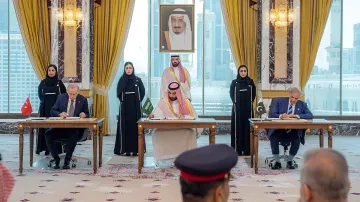
Against the backdrop of the escalation, Turkey announced its readiness to support Saudi Arabia within the framework of a trilateral defense pact concluded with Pakistan. The specific format and scope of possible assistance from Ankara have not yet been clarified. The statement sounded as a signal that the regional security architecture in the Middle East continues to transform, and that Saudi Arabia is receiving additional guarantees in the event of continued Houthi strikes on critical infrastructure.
Contradictory Data
There is a notable discrepancy between the statements of the Houthis and the military coalition. The Houthis claim that they hit "sensitive targets" in Riyadh and an Aramco facility in Yanbu, but do not name specific targets. The military coalition, in turn, reports only on shooting down one missile aimed at Riyadh and on thwarted attempts to attack other cities, without confirming the fact of hits on ground objects. Meanwhile, independent observations record flames and smoke in the area of Riyadh airport, indicating possible damage to fuel infrastructure. Saudi authorities, in the provided data, did not give a public comment on the scale of the damage, and the Houthis did not publish video materials confirming a direct hit on the terminal or Aramco facilities. Thus, the question of exactly what was hit and what the real scale of the damage is remains open.