Potatoes, beets, and carrots do not cook at the same rate: each vegetable requires its own time, with piece size and shape playing a decisive role—small chopped pieces cook noticeably faster than large whole root vegetables. Below are proven guidelines on boiling methods for salads and side dishes, compiled from recommendations by Potatoes USA, the USDA National Center for Home Food Preservation, Montana State University, and Ievhen Klopotenko's culinary website, along with safe storage rules for cooked vegetables according to FoodSafety.gov.
General Rule: Size and Shape Matter
Before putting vegetables on the heat, they should be cut into roughly equal pieces so they cook evenly and do not end up at different stages of doneness in the same pot. Large tubers and thick root vegetables are best cut into sections so that juice and heat distribute evenly, while for salads, it is important that the vegetable retains its shape when sliced after boiling.
Potatoes: From Cutting to the Fork Test
Potatoes are thoroughly washed, peeled if necessary, and cut into pieces of approximately equal size. They are placed in a pot and covered with cold water so that it completely covers the produce, brought to a boil, and then the heat is reduced. According to Potatoes USA, the approximate cooking time after boiling depends on the cutting size: the smaller the pieces, the shorter the process. A reliable indicator of doneness is the largest piece: a fork or knife should easily pass through the center, and if the flesh is still firm, cooking continues. For skin-on "jacket" potatoes, tubers of roughly equal size are chosen, for salads, maintaining shape is important, and for mashed potatoes, you wait until the flesh mashes easily.
Beets: How to Preserve Color and Sweetness
Beets are boiled whole in their skins: before cooking, they are scrubbed with a brush, leaving the taproot and about an inch of the stems to reduce color loss. According to the main method, beets are carefully lowered into boiling water that completely covers the root vegetable, and the time is counted after the boil returns. The USDA National Center for Home Food Preservation provides guidelines for young beets that increase with the size of the produce; doneness is checked with a knife in the thickest part—it should easily pass inside. Finished beets are immediately cooled in cold water and peeled. Certain publications offer different advice on water volume: UNIAN recommends not covering the beets completely, but adding water to half or two-thirds to reduce the leaching of 20–50% of potassium, magnesium, phosphorus, sodium, iron, and zinc, and up to a third of the sugar; REGIONS advises pouring cold water two to three centimeters above the level of the root vegetables and not salting the water so as not to destroy cell walls and leach out sugar and color. The approach to water volume varies among sources, so the guideline should be chosen based on desired sweetness and color.
Carrots: Whole and Chopped
Carrots are thoroughly washed, trimmed at the ends, and peeled if desired. Whole root vegetables can be covered with cold water and brought to a boil, counting the time after boiling: according to recommendations from Ievhen Klopotenko's culinary website, whole carrots or large sections need 15–25 minutes, while very thick and large ones take up to 30 minutes. Chopped carrots cook faster: according to Montana State University data, slices about 0.6–1.3 cm thick are boiled in boiling water for about 5–8 minutes until the desired softness. Doneness is checked with a knife or fork; for salads, carrots should be soft inside but hold their shape when sliced.
How to Boil Vegetables Together and Store the Finished Product
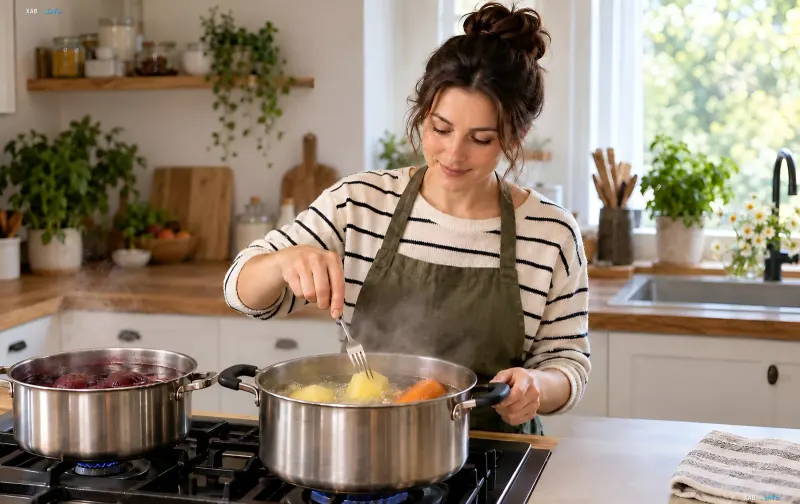
Potatoes and carrots for salads can be cooked in the same pot, but they must be checked separately and removed as soon as each vegetable is done. Beets are best cooked separately: they can stain other ingredients, and medium root vegetables usually require more time. If vegetables are prepared in advance, the water is drained and they are distributed in small portions into shallow containers. According to general FoodSafety.gov recommendations, cooked food should be cooled promptly—waiting for it to cool completely on the counter is not necessary; small portions of warm food can be placed straight into the refrigerator.