Cabbage is rarely treated as a single product in cooking: flavor, head density, and cooking behavior depend entirely on the variety. That is precisely why white cabbage is traditionally used for borscht, Savoy cabbage for stuffed cabbage rolls, and cauliflower or Brussels sprouts for roasting. Different types vary in texture and sweetness, which means the outcome of the exact same dish can change noticeably. We look at which cabbage works best for soups, salads, cabbage rolls, and roasting, drawing on recommendations from university extension services and culinary publications.
White Cabbage: The Versatile Base for Soups and Fermentation
White cabbage features a dense head with smooth, light green leaves. It is crunchy when raw, but softens and develops a sweetish flavor after heat treatment. This makes it a versatile choice for borscht, soups, stews, and cabbage rolls: the dense leaves withstand prolonged cooking well, while young cabbage with a more tender texture is especially good for fresh salads. White cabbage is also widely used for fermentation. University of New Hampshire Extension recommends choosing fresh, firm heads for this and following tested fermentation recipes, since the correct proportions of cabbage and salt directly affect the process and product safety.
Red Cabbage: A Color That Requires Acid to Hold
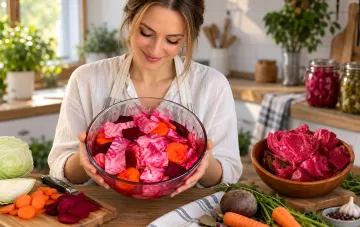
Red cabbage is distinguished by dense purple-red leaves and a sharper flavor than white cabbage. It is frequently used in fresh salads with carrots and apples, as well as for pickling, roasting, and braising. University of Illinois Extension explains that anthocyanins—plant pigments that can change color during heat treatment—give the cabbage its characteristic hue. To preserve the red shade, lemon juice, vinegar, or another acidic ingredient is added to the dish. This is why recipes featuring apples and a small amount of vinegar work so well for braised red cabbage.
Napa and Savoy Cabbage: Tenderness for Salads and Rolls
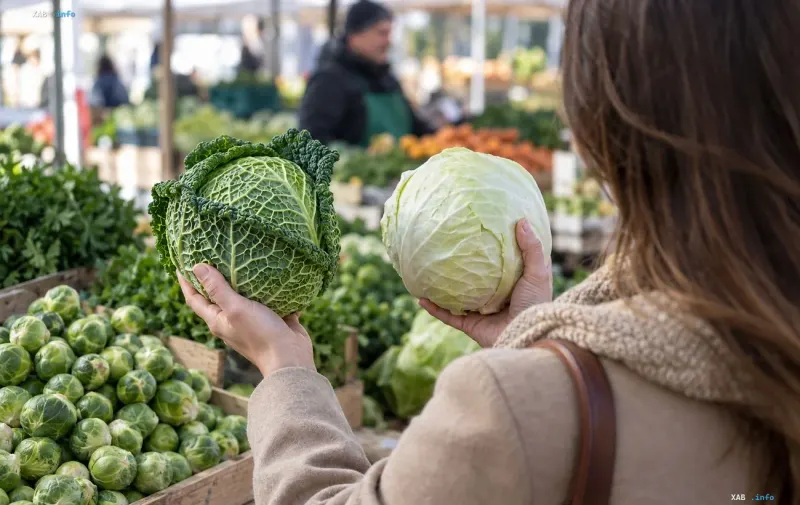
Napa (Chinese) cabbage has an elongated core, light green leaves, and thick white ribs; its flavor is mild and slightly sweet, and its leaves are more tender than those of white cabbage. It works well in fresh salads, noodle dishes, soups, quick stir-fries, and braises, and is also used to make kimchi—a traditional Korean fermented dish that, according to University of Georgia Extension, is typically combined with radish, carrots, garlic, and ginger. To keep it crunchy when stir-frying, Napa cabbage should be chopped coarsely and not cooked for too long. Savoy cabbage is recognized by its crinkled, wavy leaves: its texture is tender, its flavor mild, and its flexible leaves are convenient for cabbage rolls and other stuffed dishes. Food writer Thomasina Miers shares a recipe for stuffed Savoy cabbage in The Guardian, where the leaves are first blanched in boiling water for 3–4 minutes to make them pliable enough to wrap the filling.
Cauliflower and Broccoli: For Roasting and Cream Soups
Cauliflower is unique in that its dense head, formed of underdeveloped flower clusters, is used for food. Its mild flavor pairs well with spices, cheese, and sauces; it can be roasted, steamed, pan-fried, or used in cream soups and mashes. As Iowa State University Extension explains, it is prepared whole or broken into florets beforehand: for roasting, the florets are tossed with oil and spices, spread in a single layer on a baking sheet, and cooked until browned, while for mashes or cream soups, they are boiled longer so the mixture is easy to blend. Broccoli features green florets and sturdy stalks, which are also edible once any tough outer skin on larger stalks is trimmed off. Specialists at the Alabama Cooperative Extension System recommend roasting broccoli with oil, garlic, and spices, steaming it, or adding it to salads and hot dishes: the florets are arranged in a single layer and baked at about 220 degrees Celsius for 14–18 minutes until the edges brown and the stalks soften. To maintain a firm texture, broccoli should not be boiled for too long, whereas for a cream soup, it is cooked until tender.
Practice: From Choosing the Head to Preparing the Leaves
Choosing cabbage starts with understanding what dish you are making: dense heads for long braising and fermenting, tender leaves for salads and cabbage rolls, and florets for roasting. Among long-growing varieties, Brussels sprouts are considered the most unpretentious and, according to kp.ru, are well-suited for roasting. When preparing leaves for cabbage rolls, it is not necessary to boil an entire head in a large pot: following advice published by Glavred with reference to Kuchnia, the head is slit widely on the side to loosen the leaf attachments at the base, after which the leaves are removed and dropped into boiling water in small batches—six to seven at a time—for a few minutes before being cooled on a plate or board. This method eliminates the need to constantly turn the head and saves time, especially when the leaves are not packed too tightly.