Amid regular power outages, the issue of backup power for apartments or houses has evolved from a niche concern into a practical necessity for millions of Ukrainian consumers. The RBK-Ukraine portal conducted a comparative review of portable and stationary energy storage stations from three leading brands — EcoFlow, Bluetti, and Marstek — across three price segments to help readers navigate the variety of models and select a solution that fits their specific needs and budget.
Power and Capacity: Two Parameters to Understand Before Buying
Before comparing specific models, it is important to grasp two key characteristics. Power (measured in watts) determines which appliances the station can run simultaneously. Capacity (in kilowatt-hours) indicates how long these appliances will run without a recharge. For instance, a 300W station will easily keep a router running for a full day but won't start a refrigerator. A 2 kWh, 1200W model will handle a laptop, a fridge, and a TV, but is unlikely to cope with an electric kettle. That is why choosing a station starts not with the price, but with an inventory of the devices that need to function during a blackout.
Portable or Stationary: Two Fundamentally Different Formats
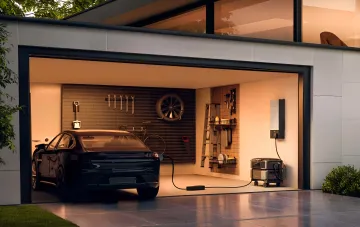
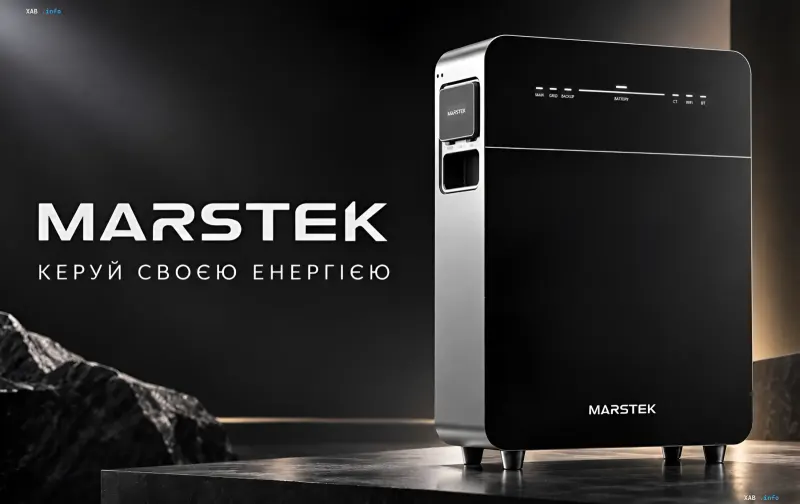
A portable station works like a large power bank: it is charged from a standard wall outlet, and when the power goes out, appliances are plugged directly into the device. This format allows you to carry the station between rooms, or take it to the office or a country house. For Marstek, the portable line is represented by the Mercury series, for EcoFlow by DELTA, and for Bluetti by the AC series. A stationary energy storage system, such as Marstek Venus, EcoFlow STREAM, or PowerOcean, is installed once and integrated into the home's electrical grid. It accumulates energy while the power is on and provides backup supply during outages. In the case of Marstek, you can manage charge and discharge cycles via a mobile app, making the system useful not just during blackouts, but for optimizing everyday energy consumption.
Budget up to 40,000 Hryvnias: Marstek Mercury M1200, Bluetti AC180, and EcoFlow DELTA 2
In this segment, stations with a capacity of about 1 kWh and an output power of around 1800W compete. As a rule, these are sufficient for the simultaneous operation of a refrigerator, a gas boiler, a TV, a computer, a router, and lighting, provided the total load does not exceed the stated specifications. Since the power and capacity of the three models are in the same class, secondary parameters become decisive. Battery life: for EcoFlow DELTA 2, more than 3,000 charge-discharge cycles are claimed; for Bluetti AC180, more than 3,500; and for Marstek Mercury M1200, the manufacturer indicates over 6,000 cycles. If the station is discharged daily in winter, 3,000 cycles roughly equate to eight years of such a regime, while 6,000 is twice that. Charging speed also varies: Marstek Mercury M1200 restores its charge from the mains in about an hour, EcoFlow DELTA 2 in approximately 80 minutes, and Bluetti AC180 in about 1.5 hours. When power is available for only two or three hours, this difference determines whether the station can recharge before the next outage. The weight of all three models is comparable — in the range of 12–16 kg, allowing the device to be carried between rooms.
Compact Solutions for Minimal Needs
If lighting, a router, and a laptop are the priorities, you can manage with a significantly smaller budget. Compact Marstek A300 Pro (294 Wh, 300 W) and A500 Pro (518 Wh, 500 W) cost between 10,000 and 16,000 UAH in Ukrainian stores and weigh 6–7.4 kg. The charging time is about 1.5 hours, and in turbo mode, from 0% to 80%, it takes about 45 minutes. For basic tasks during short-term outages, this is more than enough.
Budget Around 50,000 Hryvnias: 2 kWh Class Stations and Stationary Alternatives
For 50,000 UAH, you can purchase a 2 kWh, 2400W class portable station, which will run a refrigerator, boiler, pump, computers, and lighting simultaneously, providing several hours of autonomy for all basic equipment. In this segment, Marstek Mercury M2200, Bluetti AC200L, and EcoFlow DELTA 2 Max are available. Charging speed is not a differentiating factor here: all three models have an input power from the grid reaching 2–2.4 kW. Therefore, capacity and price become the key criteria. Marstek Mercury M2200 stands out with the largest capacity of the trio — 2.24 kWh — at the lowest cost of 45,000–55,000 UAH; charging takes from 70 to 90 minutes. Bluetti AC200L (2048 Wh) is sold for approximately 59,000–83,000 UAH, while EcoFlow DELTA 2 Max (2048 Wh) ranges from 52,000–85,000 UAH. An alternative to the portable format in this budget is a stationary system: Marstek Venus-A (2.12 kWh, 1200W backup power) costs 28,000–35,000 UAH and can be expanded with additional batteries up to 12.72 kWh with the option of connecting solar panels with a capacity of up to 2400W. The system has IP65 protection and a stated operating temperature range from −20 to +60 °C, allowing it to be installed on a balcony, in a garage, or an unheated room. A competitor is the EcoFlow STREAM Ultra (1.92 kWh, 1.2 kW, expandable to 11.52 kWh) costing 43,000–60,000 UAH.
Budget from 100,000 Hryvnias and Above
In the higher price segment, RBK-Ukraine compares four options, including models from Marstek, EcoFlow, and Bluetti with increased capacity and extended capabilities for integration into a home energy system. Specific specifications and prices for this segment depend on the configuration and additional modules that allow scaling the system to the needs of a private house or a small office. All prices provided in this review are indicative and are based on data from Ukrainian stores as of November 2026.