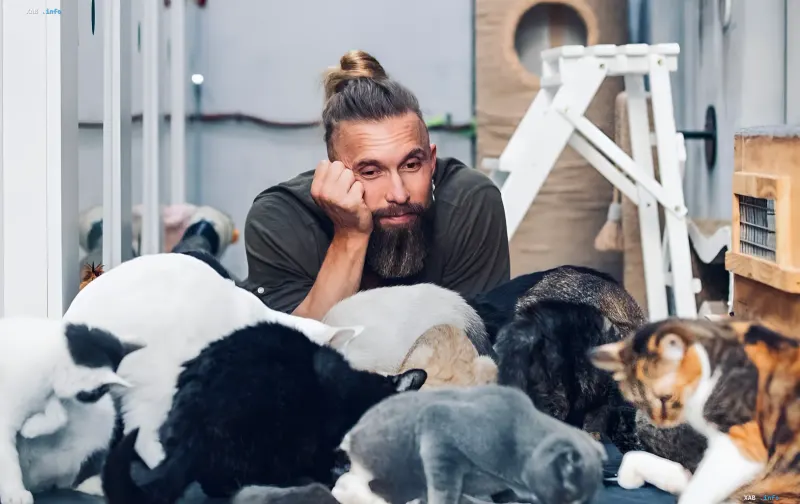
Oleksii Surovtsev is a Ukrainian actor and animal rights activist who, during the battles for Irpin in 2022, rescued animals from burning houses and later founded the "Bearded Cat Mom" shelter. Today, his team cares for dozens of cats amidst regular shelling, hours-long power outages, and quarantine. In an interview with Wave RBC.UA, Surovtsev detailed how owners should act in the first minutes after an explosion, why an animal's external calmness can be misleading, and how to restore a pet's trust after episodes of aggression. The conversation also touched upon the shelter's daily work during blackouts and the specific types of assistance the organization needs.
First rule: do not panic yourself
According to Surovtsev, animals read an owner's emotional state, behavior, and intonation with extreme precision. If an owner starts screaming, running around the apartment, or grabbing a cat or dog, it multiplies the pet's fear. "The very first rule is not to panic yourself," he emphasizes. At the same time, human safety remains the absolute priority: spending precious minutes searching for a cat all over the apartment during shelling is not worth it, and risking one's life trying to pull an animal out of a hard-to-reach place is strictly discouraged. The best help, according to Surovtsev, is advance preparation: getting the animal used to a carrier and a shelter even before the first siren sounds.
What not to do: punishment and coercion
One of the key points of the interview is the absolute ban on punishing an animal for fear. Screaming, hitting, pulling, forcibly dragging from under the couch, or tightly hugging a struggling pet are all perceived by the animal as an additional threat. This is especially true for cats: the opportunity to hide and control the distance is one of their main mechanisms for coping with stress. "If a cat crawled under the couch and it's safe there, let it sit," Surovtsev says. At the same time, ignoring the animal out of fear of "reinforcing fear with affection" should also be avoided: fear is an emotion, not bad behavior, and if a dog seeks contact itself, it can be gently petted.
Cats and dogs: different survival strategies
Surovtsev emphasizes that every animal is individual, but a general trend is visible. Dogs in most cases look to the owner: human presence, a calm voice, and familiar commands are important to them. Cats, on the other hand, more often try to find a safe place where no one will touch them. "Give the cat the right of choice. If it wants to hide, let it hide. If it wants to come to you, accept it. Do not force contact," he formulates. Practical conclusion: pre-arrange several safe hiding places in the apartment from which the animal can be quickly evacuated if necessary, without forcing it out of the shelter by strength.
Medication "on emotions" is a path to disaster
When asked whether a pet can be given calming drops directly during an explosion, Surovtsev answers unambiguously: absolutely not. "Especially human medicine. Some of them can be toxic to cats and dogs," he warns. Moreover, not every drug that makes an animal less mobile actually reduces its fear — sometimes it is simply nervous system depression. Effective veterinary remedies to reduce anxiety exist, but they are selected by a doctor taking into account the health condition of a specific animal. Some drugs are used before predictable stressful events, others require a longer course. "This must be a prepared plan, not an experiment during an explosion," Surovtsev summarizes.
Getting used to war: the illusion of calm
Many residents of relatively peaceful regions are afraid to bring animals to Kyiv or other cities due to constant explosions. Surovtsev acknowledges that animals are indeed capable of adapting to repetitive sounds, but makes an important caveat. "An outwardly calm animal does not necessarily stop being afraid. Sometimes it just freezes or suppresses behavioral reactions, although physiological stress remains." Therefore, he does not dare to say that cats or dogs "get used to war": they adapt to certain conditions, but this does not mean that constant explosions are harmless to them. Before moving, it is necessary to get the animal used to a carrier and transport, and take things with familiar smells to the new home — a bed, toys, the owner's clothes.
The shelter during blackouts: everyday life that is rarely talked about
The work of the "Bearded Cat Mom" in 2026 is not only caring for cats, but also daily solving logistical tasks amidst power outages. Surovtsev's team provides animals with warmth, food, and water when external infrastructure is down. In the interview, he spoke about specific types of assistance the shelter needs and how to restore the trust of a cat that stopped approaching humans after an episode of aggression or panic. "Trust cannot be forced back," Surovtsev emphasizes, and this phrase essentially becomes the motto of all his work: from the first minute of shelling to the months-long recovery of the pet in the shelter.