Improper frost protection can harm roses more than the cold itself. If moisture accumulates under the cover and temperatures rise during thaws, shoots begin to rot and become susceptible to fungal diseases. This is why the question of "how to cover roses for winter" is not about packing the bush as tightly as possible, but about maintaining stable temperature conditions and preventing frequent freezing and thawing — as the University of Illinois defines the main goal of cold-season protection.
The main risk: premature and airtight covering
The desire to protect plants from the first autumn frosts often leads to premature insulation. If air temperatures remain above freezing for a long time, heat and moisture accumulate under airtight covers, preventing plants from gradually entering their winter dormancy state. Specialists at University of Illinois Extension recommend not rushing the insulation: roses should first undergo natural hardening after stronger autumn frosts. Hybrid teas, floribundas, and other less winter-hardy varieties require special attention, whereas some hardy shrub roses can winter without additional insulation.
Materials: why plastic film is more dangerous than landscape fabric
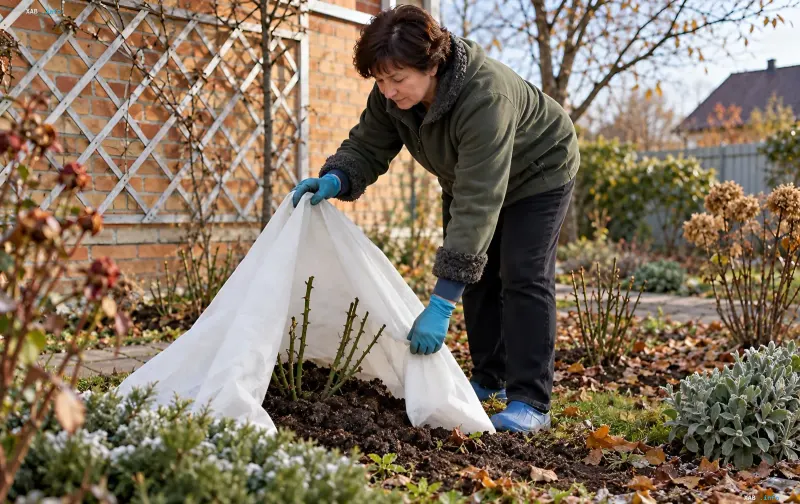
Polyethylene film does not breathe well. If you wrap a rose in it without ventilation, condensate accumulates inside, and on sunny days, the temperature under the film rises, only to drop sharply at night — these fluctuations create additional stress on the plant. The Royal Horticultural Society (RHS) explains that garden landscape fabric (fleece), due to its porous structure, is significantly less prone to overheating and moisture accumulation than plastic covers. However, even landscape fabric should not be left unchecked throughout the winter, especially if the weather is volatile, and it is best placed on frames that keep the material from pressing directly against the shoots.
Pruning and mounding: what to do in autumn and what to postpone
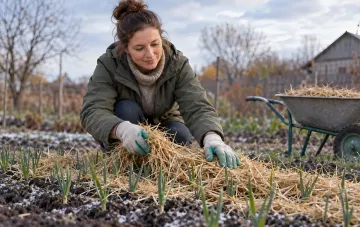
Fallen leaves and dead plant parts can harbor fungal pathogens; if such debris remains in a humid environment without sufficient air circulation, the risk of shoot infection increases. Therefore, it is important to remove affected shoots and ensure good air circulation for prevention. That said, heavy formative pruning should not be performed in autumn without necessity — for many groups of roses, it is better to leave major pruning for spring. Mounding the base of the bush helps protect the graft union and the lower part of the shoots from severe frost, but the material must be loose and well-drained: according to University of Illinois Extension recommendations, a mixture of loose soil and compost is suitable for mounding, which does not trap excess water, and soil should not be scraped directly from around the roots to avoid damaging the root system. Fresh manure, wet grass, and materials that compress quickly are not recommended for insulation.
Thaws, ventilation, and damage diagnosis
During prolonged warming spells, heat and moisture accumulate under protective materials, especially in poorly ventilated structures. According to the Royal Horticultural Society, during periods of very mild weather, protective covers should be removed to prevent rotting and suffocation, and re-installed when cold returns; during thaws, it is necessary to check the state of the bushes and provide ventilation if needed. Leaving roses under dense material after steady warmth arrives is undesirable: rising temperatures can stimulate premature growth, which will be damaged by returning frosts. The first signs of problems often become visible at the end of winter or after removing the cover, but they do not always indicate rotting — the University of Illinois describes fungal shoot lesions as brown, oval, or sunken spots, which are sometimes mistaken for frost damage. Therefore, before pruning, it is important to assess the state of the tissues and not remove healthy parts of the plant unnecessarily.