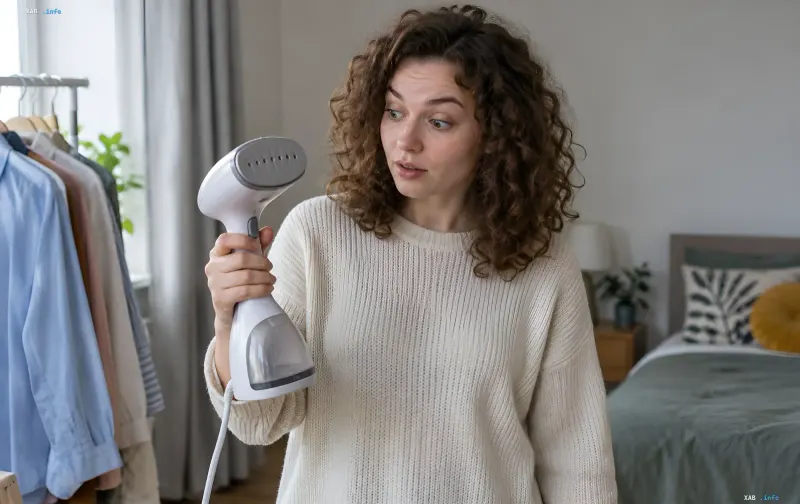
A handheld garment steamer is one of the most convenient devices for quickly refreshing clothes, but over time it starts to «act up»: steam output becomes weaker, white marks remain on fabric, and water spits from the nozzle. According to Styler (a RBC-Ukraine project), in most cases, the cause is the buildup of mineral scale. Tap water contains dissolved calcium and magnesium compounds that form hard deposits inside the appliance when heated. The harder the water in your region, the faster scale accumulates and the more frequently maintenance is required.
Signs That It Is Time to Clean the Appliance
The need for cleaning is indicated by characteristic symptoms: a decrease in steam volume, white mineral streaks on clothing, and water spattering. However, as the authors of the material emphasize, not every one of these signs points specifically to scale. Before starting the cleaning process, you should check the water level in the reservoir and ensure it is properly installed. There is no universal method for cleaning steamers: depending on the design, the manufacturer provides for water flushing, a special drainage plug, or a self-cleaning function.
Built-In Descaling Functions
Official Philips recommendations describe several ways to remove scale. For a number of models, a function is provided that is activated by simultaneously pressing the settings and steam buttons — during the procedure, hot water along with mineral deposits exits the appliance. This cleaning must be performed over a sink, strictly following the instructions for your specific model. There are also steamers whose design does not require manual descaling: for models with Quick Calc Release and Easy Rinse-Off Scale functions, the manufacturer recommends cleaning about once a month, or more often if water hardness is high. If you do not know the exact model, look for markings on the housing, handle, or under the water reservoir.
What Not to Do: Vinegar and Other Liquids
Although vinegar is indeed capable of dissolving limescale, its acidity can damage the internal parts of the appliance. Some manufacturers allow the use of such a remedy, but this method can only be used when it is explicitly permitted by the specific model's manual. Without the manufacturer's permission, do not pour foreign liquids into the reservoir — they can cause stains on clothes, disrupt steam supply, or damage the device itself.
Care for the Casing, Attachments, and Proper Water Selection
Dust, fabric lint, and limescale accumulate on attachments and the casing. As Better Homes & Gardens recommends, before cleaning, you must unplug the steamer, wait for it to cool down completely, and empty the reservoir; for external surfaces, warm water and a microfiber cloth are sufficient. Before reconnecting, make sure that the cleaned surfaces and attachments are completely dry, and after descaling, test the steam output on an old towel so that leftover deposits do not stain clothes. Distilled water is not suitable for all steamers: for example, the Rowenta Pure Pop manual states that in areas with high water hardness, tap water and distilled water can be mixed in a 1:1 ratio, while boiled, filtered, bottled, scented, and rainwater are not recommended by the manufacturer. Good Housekeeping experts advise emptying the reservoir after the appliance has cooled before storing it. If the steamer continues to leak, heats up poorly, or fails to produce steam after cleaning, stop using it and contact a service center — specialists do not recommend disassembling heating and electrical components on your own.