Washington, August 12, 2026 — The international human rights organization Human Rights Watch (HRW) has officially appealed to the US Congress with an urgent demand to block a potential deal for the re-export of cluster munitions from Turkey to Ukraine. The deal concerns a large batch of obsolete US-made weaponry, with a total estimated value ranging from $256 million to $280 million.
"Timers" in the sky: technical threat to the civilian population
The central argument of the human rights defenders is based not on a political issue, but on purely technical safety. According to HRW, a significant portion of the planned weaponry was produced more than 30 years ago. The organization's experts warn: the expiration of warranty storage periods critically increases the percentage of unexploded sub-munitions (duds) upon impact.
Unlike modern munitions, old mechanisms may fail to detonate upon impact with the ground, turning into effective delayed-action mines. This creates long-term risks for the civilian population, complicates the humanitarian situation, and makes subsequent demining of territories an incredibly laborious and dangerous process. HRW emphasizes that the use of such munitions effectively turns battlefields into minefields for decades to come.
Supply nomenclature: scale of the threat
The proposed military aid package, notification of which the US State Department sent to Congress, includes an impressive arsenal of ordnance:
- 70 M39 tactical ballistic missiles (ATACMS Block I) with cluster warheads. They contain approximately 66,500 M74 sub-munitions.
- 2,524 unguided M26 rocket projectiles for multiple launch rocket systems. This amounts to over 1.6 million DPICM sub-munitions.
- 47,000 M509A1 artillery shells of 203 mm caliber, containing approximately 8.46 million sub-munitions.
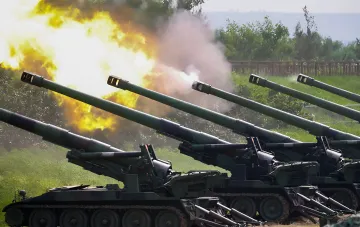
- 12 M270 MLRS launchers for their deployment.
The total volume of sub-munitions is counted in millions of units, making the question of their reliability critically important for regional security.
Positions of the parties and regulatory context
The situation is developing within a complex legal framework. Since the weaponry was produced under US license, its transfer to a third party requires permission from the US administration. In the documents submitted to Congress, the Turkish side explains the transfer as a necessity for the scheduled modernization of their own arsenals and the decommissioning of obsolete types of projectiles. The Ukrainian side, in turn, is counting on strengthening the firepower of its artillery and missile units.
Although neither the US, nor Ukraine, nor Turkey are participants in the 2008 Convention on Cluster Munitions, US legislation has internal restrictions on the export of ordnance with a high dud rate. Legislators have 15 days from the date of receiving the notification to consider the deal. The US Congress has the authority to adopt a Joint Resolution of Disapproval to block the issuance of an export license.
Contradictory data
The issue of the reliability of obsolete munitions causes disputes between human rights defenders and military experts. On the one hand, HRW insists that the age of the munitions makes them unsuitable for safe use due to the risk of unexploded elements. On the other hand, representatives of the defense industry and military analysts may point out that the munitions have undergone necessary conservation and inspection procedures, and their characteristics meet safety requirements despite their age. This contradiction requires careful independent expertise before making a final decision.