Amid persistent restrictions on the Chinese industry's access to advanced chip manufacturing equipment, Huawei has bet on a fundamentally different die layout rather than shrinking process nodes. A key element of this strategy is the LogicFolding architecture, first introduced in May 2026 at the International Symposium on Circuits and Systems (ISCAS 2026). According to the company, the solution uses over 50 million hybrid connections and increases transistor density by 53.5%. Huawei's semiconductor division attributes this concept to the so-called "Tau scaling law": instead of racing to reduce the physical size of transistors, engineers are reducing the time signals and data travel within the chip by moving from a single-layer to a double-layer design.
First results exceed internal expectations
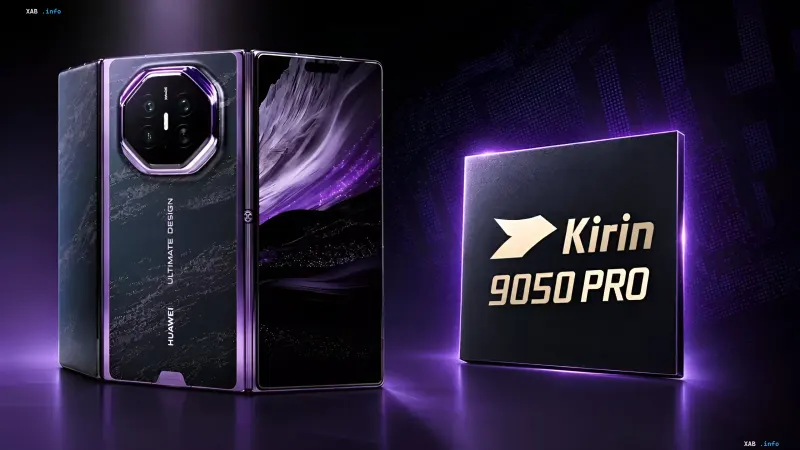
The first series to feature the new architecture was the Kirin 9050 line, including the flagship Kirin 9050 Pro, which the company positions as the most powerful chip in its history. According to Chinese media, there were initial doubts within Huawei about whether LogicFolding could be scaled for mass production without compromising yield. However, as the company stated, preliminary tests of the processor planned for 2027 (internally designated as Kirin 2026) are already meeting defined goals. The head of Huawei's semiconductor division, He Tingbo, noted that the new chip will bring a significant boost in overall performance compared to its predecessors.
Comparison with Apple and Qualcomm is still premature
It is important to note that Huawei has not disclosed quantitative metrics for the future chip: data on computational performance, graphics sub-systems, and AI acceleration have not been officially released. Therefore, a direct comparison of the Kirin 9050 Pro and the 2027 chip with current flagship processors from Apple and Qualcomm, which use more advanced production nodes, is incorrect at this stage. A realistic benchmark for the company remains its own previous generations: according to Huawei, the Kirin 9030 Pro released last year had reached a performance saturation zone under the old approach, and it was to overcome this "ceiling" that the double-layer architecture was developed.
The 100 millionth chip and new market risks
An additional indicator of the company's progress is the milestone of 100 million Kirin chipsets shipped since 2023, when Huawei returned to the market with the Kirin 9000S. This volume was achieved despite sanctions and reliance on domestic Chinese production capacity. At the same time, a new problem lies ahead that is not related to architecture: a global shortage of RAM is increasing component costs and may force Huawei to revise its smartphone pricing policy. Even successful engineering optimization of the chip layout does not negate basic market realities, and the ultimate competitiveness of the devices will depend not only on the chip but also on the cost of components.