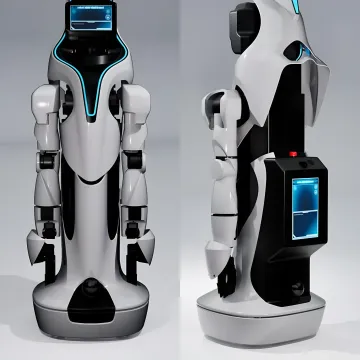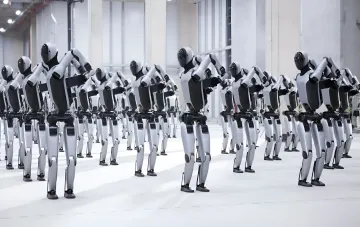
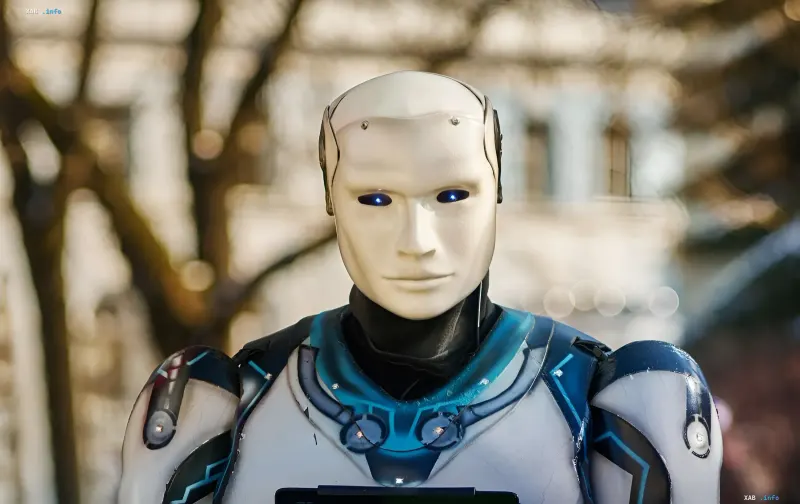
At the IFA 2026 international exhibition in Berlin, robotics has ceased to be an exclusively futuristic concept: the pavilons showcased five humanoid robots that, according to their developers, could appear not only in enterprises but in ordinary apartments in the near future. The machines differ markedly in size, purpose, and price — from compact models for learning and home companionship to full-size humanoids designed for complex tasks and even police patrol. The common denominator of all the machines on display is a focus on multimodal speech recognition, spatial orientation using LiDAR, and extended autonomous operation.
Compact models for home, learning, and competitions
Among the compact solutions stands out a bipedal robot 68 cm tall and weighing 28 kg, which visually resembles Disney's Wall-E character. At its core is an eight-core Horizon Sunrise processor, a LiDAR scanner, and cameras, which allow the machine to navigate any terrain, carry loads of up to 20 kg, and operate for up to 25 hours without recharging. The model is aimed at household routines, security, and entertainment, and its price starts at $7,999. Next to it is a compact 95-centimeter robot weighing 19.5 kg, developed for university programs, AI laboratories, and robotics competitions: it supports NVIDIA AGX Orin computing modules (200 TOPS), runs on Python and ROS/ROS 2, and during demonstrations skillfully kicked a ball into the goal and recreated the celebrations of famous footballers. Its price starts at $5,999. Another compact model, 88 cm tall, was created for academic research, classroom use, and home companionship: 22 degrees of freedom and a drive with full torque control allow it to run at speeds of up to 3.2 m/s and perform more than 10 martial-arts movements; the body can be customized with 3D-printed parts, and the battery holds a charge for up to 3 hours.
Full-size humanoids for complex tasks
A full-size humanoid 173 cm tall and weighing 55 kg, made from magnesium-titanium alloys, is equipped with modular OmniHand hands featuring 12 degrees of freedom: this allows it not only to hold a pen but to carefully write Chinese characters. A dual-battery system provides up to 10 hours of operation with hot-swapping in 10 seconds, and a UWB module allows several robots to be synchronized for group performances. The second full-size machine — a 173-centimeter body made of aviation aluminum — was created for difficult tasks and mobility; in China, similar models are already being tested for police patrol. The humanoid accelerates to over 3 m/s, has 29 degrees of freedom, and its computing system based on NVIDIA Jetson Orin NX and Intel, combined with 360-degree LiDAR, ensures instant obstacle detection; the battery guarantees up to 5 hours of operation.
From the lab to the buyer: what analysts say
Analysts emphasize that IFA 2026 confirmed robotics' confident step from laboratories and the B2B segment to the consumer B2C sector. Most developer companies focus not only on physical capabilities — joint flexibility, walking speed, number of degrees of freedom — but also on multimodal speech recognition systems, spatial orientation using LiDAR, and the duration of autonomous operation. Tech companies are convinced that in the foreseeable future humanoids will not only simplify production routines but also become indispensable helpers in household chores, childcare, and leisure.
Context: autonomous football and races in China
The machines shown in Berlin fit into a broader trend that other venues have also vividly demonstrated. Thus, at RoboCup 2026, Chinese humanoids drew attention with autonomous football played without human involvement, and at the Beijing half-marathon, humanoid robots made a breakthrough in speed, overtaking professional athletes. These demonstrations underscore that the speed, coordination, and autonomy of humanoids are growing faster than was expected just a couple of years ago.
Contradictory data
When comparing figures from different sources and demonstrations, notable discrepancies arise that should not be mixed up. The autonomy and speed metrics of the five Berlin models vary widely — from 3 to 25 hours of operation and from 3 to 3.2 m/s running speed — which reflects each machine's different target niche, not a data error. Moreover, the bold claims that humanoids overtook professional athletes in a half-marathon and played autonomous football refer to separate Chinese events (RoboCup 2026, the Beijing half-marathon), not to the consumer models from IFA 2026, whose specifications are more modest. Therefore, comparing the 'record' running speeds with the technical passports of home robots is correct only as different contexts, not as conflicting assessments of the same device.