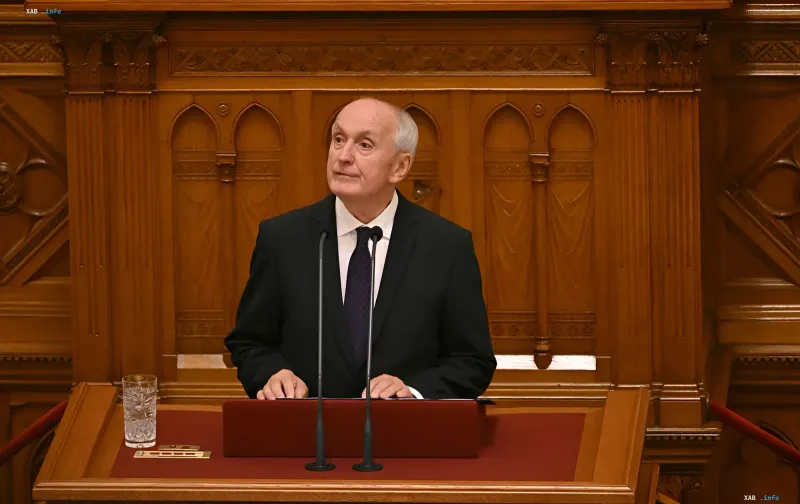
On August 11, 2026, Hungary experienced a historic political shift, marking the final transition of power from Viktor Orbán's regime to a new government led by Péter Magyar. The country's parliament unanimously supported the candidacy of former Supreme Court judge András Baka for the presidency. This appointment became a key element of the new government's strategy to dismantle the institutional legacy of the Fidesz party, which had ruled for over a decade.
Voting Details and Political Context
The parliamentary vote resulted in 140 votes in favor and 6 against. Notably, representatives of the Fidesz party, led by Viktor Orbán, boycotted the voting procedure, refusing to participate in the selection of the head of state. This decision became a symbol of the old guard's refusal to take part in shaping the country's new political reality. Baka's candidacy was presented by Prime Minister Péter Magyar as a choice in favor of the rule of law and the independence of the judiciary, which stands in direct opposition to the course of the previous leadership.
Who is András Baka and his conflict with Orbán
András Baka is a figure with a rich legal biography. Before his election, he held the positions of head of the Hungarian Supreme Court and judge of the European Court of Human Rights. His career in the highest judicial bodies was interrupted in early 2012 when Viktor Orbán removed him from the position of President of the Supreme Court, which became one of the first steps towards centralizing power and weakening the independence of the judicial branch. Now, more than a decade later, Baka returns to the pinnacle of state power, replacing Tamás Sulyok, who resigned under pressure from the new government in July 2026.
Impact on Relations with the EU and the Economy
The appointment of Baka is of critical importance not only for domestic politics but also for Hungary's relations with the European Union. Although the Hungarian president formally possesses limited executive powers, he is endowed with the right of veto on laws or the ability to refer them for review to the Constitutional Court. The new government feared that a pro-Orbán president could use these levers to block reforms necessary to unlock billions of euros of frozen EU funding. With Baka's arrival, these risks have been minimized, opening the way to restoring normal dialogue with Brussels.
Contradictory Data
Despite optimism in government circles, experts point to the complexity of the upcoming reforms. Commerzbank economist Tati Ghosh notes that while Baka's appointment is a symbolically important step, the full dismantling of Orbán's system will not happen instantly. According to him, the state apparatus is still under the strong influence of the previous regime, and changing established bureaucratic policies will take significant time. There is a risk that institutional inertia may slow down the implementation of the new government's plans, despite the change in formal leaders.
Impact on Ukraine's Euro-Integration
In the context of the Ukrainian agenda, the change of president in Hungary carries mixed expectations. On the one hand, the new course of Magyar and Baka could mean a refusal to veto Ukraine's Euro-integration, which was actively used under Orbán. On the other hand, the current position of Magyar's team remains restrained: Budapest continues to postpone the opening of negotiation clusters on access to the single market and opposes accelerating Ukraine's accession process to the EU. Thus, although the political vector has changed, practical steps to support Ukraine remain at the discussion stage.