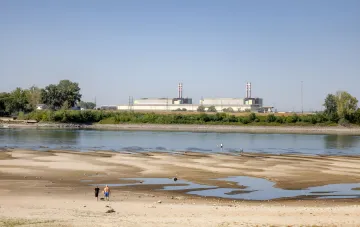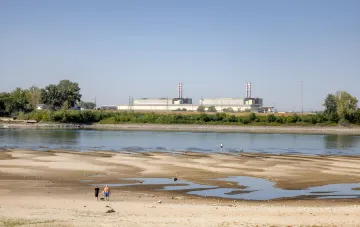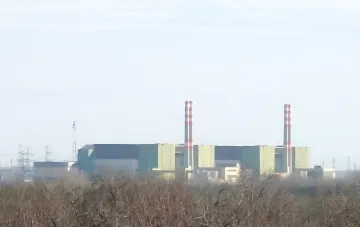
Hungary is facing five critically difficult days. The country, which has relied on the stable operation of its power system for decades, is now confronting an unprecedented challenge: the drying up of the Danube River is forcing the country's only nuclear power plant — Paks — to shut down for the first time in the last forty years. The situation is exacerbated by forecasts of a new wave of anomalous heat.
Critical Drop in Danube Levels
As of Tuesday evening at 21:37 Kyiv time, the Paks NPP, with a capacity of 2 gigawatts and providing about half of the country's electricity needs, was operating at only 10% of its capacity. The reason is simple and fatal for power generation: the level of the Danube, whose water the plant uses to cool the reactors, has fallen to record lows.
Hungarian Prime Minister Viktor Orbán, in his video address on Facebook, warned the population of the inevitable: "We are facing the most difficult five days ahead. Tomorrow, the Paks plant will not generate electricity, and the hottest days with temperatures of 40 degrees are ahead."
Threat of Energy Collapse
Power grids, utility services, and ordinary households will face colossal loads. The plant, equipped with four Russian-made reactors, may be idle for several weeks. Orbán clarified that the decision on a full shutdown will be made by the NPP management in strict accordance with safety protocols, however, the risks remain maximum.
The government has already taken preventive measures. Following an official appeal, voluntary reduction of electricity consumption by households and more than 300 companies allowed reducing demand by 400 MW. Among those who joined the saving program are the Hungarian energy group MOL, the South Korean giant Samsung SDI, the premium car brand Audi, and the Japanese supplier Denso.
"There is currently no need for mandatory electricity consumption restrictions for companies," Orbán stated, but added that the government could introduce strict restrictions as early as Monday if the situation worsens.
Economic and Social Consequences
The crisis goes far beyond the energy sector. The drop in water levels has disrupted shipping and tourist flows. Water usage restrictions have been introduced in more than 100 towns and villages, including the outskirts of Budapest.
The economic cost of the crisis could be huge. According to the deputy chairman of Orbán's party "Fidesz", Márk Tóth, Hungary could lose between 100 and 200 billion forints ($315–630 million) due to the need to urgently import electricity at inflated prices.
Regional Scale of the Problem
The problem is not limited to Hungary's borders. Anomalous heat is hitting all of Central and Eastern Europe. Since August 3, Ukraine also forecasts an increase in electricity consumption by a full gigawatt. In Georgia, a massive blackout was recorded for the second time in two days: Tbilisi and major cities were left without light, and the metro, water supply, and transport systems operated with serious disruptions.