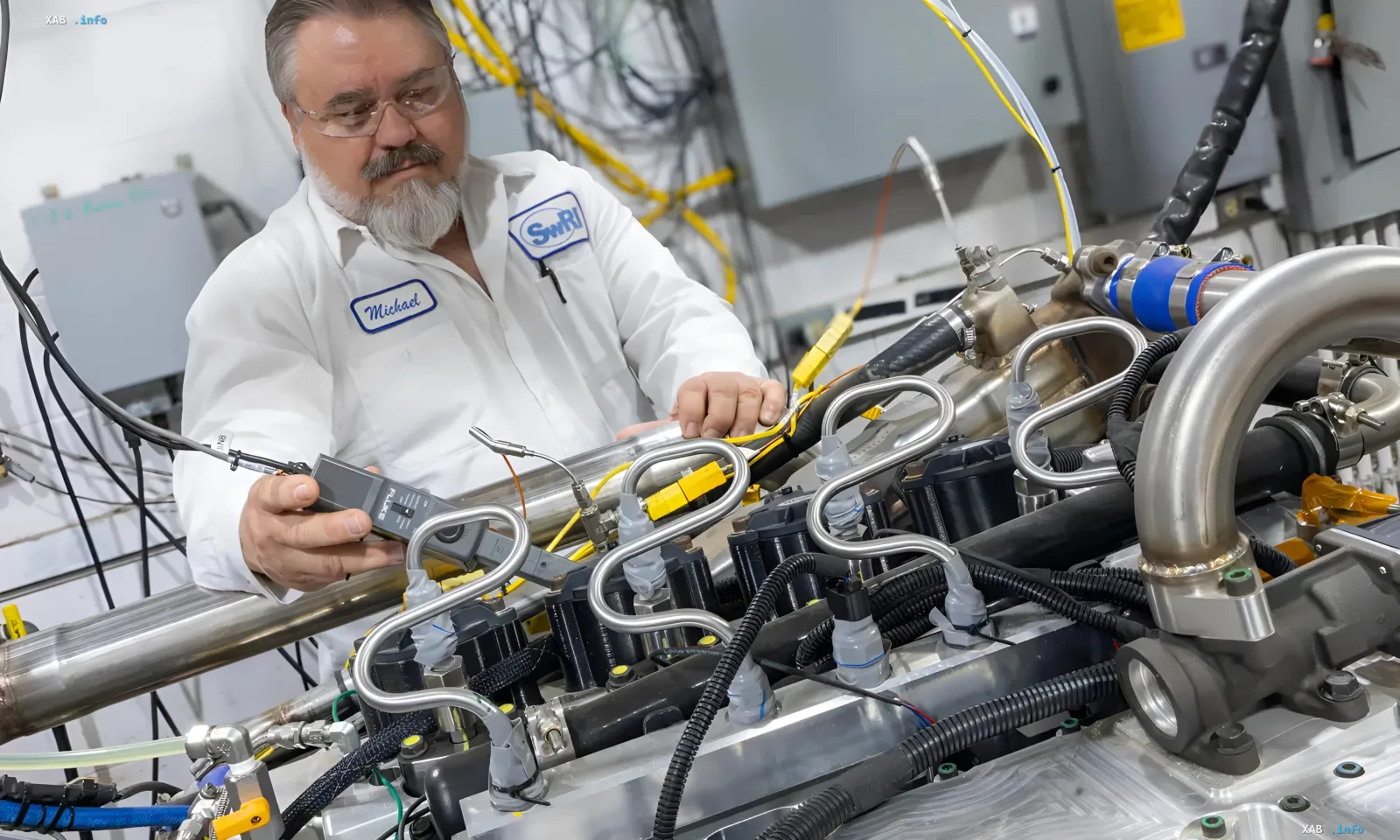
In the global search for alternatives to fossil fuels, engineers at the Southwest Research Institute (SwRI) in the USA have presented a breakthrough solution for heavy industry. In August 2026, a new internal combustion engine (ICE) running on hydrogen was successfully tested. Unlike the popular fuel cell concept, where hydrogen is converted into electricity, this solution uses classic mechanics: hydrogen burns in the cylinders, driving the pistons. This approach opens the path to decarbonizing medium-duty commercial transport without a complete paradigm shift in automotive manufacturing.
Technological Adaptation: From Gasoline to Hydrogen
Development proceeded in stages, starting with an experimental single-cylinder prototype. SwRI engineers faced a complex challenge: to make hydrogen work in an ICE as efficiently and stably as diesel fuel. The key feature of the new engine is the imitation of diesel characteristics — high torque at low RPMs, which is critical for trucks and special equipment. To achieve this goal, the engine was equipped with a turbocharger, which ensures the necessary air intake for burning a larger volume of hydrogen.
The intake system underwent serious modification. Since hydrogen burns significantly faster than gasoline, standard channel geometry proved unsuitable. SwRI developed special intake channels and enlarged valves optimized for forming the ideal air-fuel mixture. The process is managed by complex real-time software that synchronizes the operation of injectors, ignition, and boost pressure.
Fighting Pre-ignition
One of the main engineering challenges was preventing detonation and pre-ignition. Hydrogen is highly flammable and can ignite from contact with hot parts or residual gases even before the spark plug fires. This phenomenon, known as "pre-ignition," can lead to unstable operation and engine destruction. A significant part of the testing was dedicated to refining injection strategies and temperature regimes to avoid these risks and ensure smooth engine operation.
Environmental Balance and Infrastructure
The main advantage of a hydrogen ICE is the absence of carbon in the fuel. No carbon dioxide (CO₂) is formed during combustion in the cylinder; the main product of the reaction is water. However, such an engine cannot be called completely eco-friendly: nitrogen oxides (NOx) are formed from the air at high combustion temperatures. Solving this problem requires precise control of the combustion process and possibly the use of exhaust gas cleaning systems.
SwRI considers the ability to preserve existing automotive infrastructure a strategically important factor. Switching to hydrogen ICEs will allow manufacturers not to abandon accumulated competencies, production lines, and service processes, making the technology more accessible and faster to implement compared to switching to electric vehicles or hydrogen fuel cells.
Contradictory Data
Currently, there are discrepancies regarding the exact characteristics of the new engine. SwRI engineers have not yet disclosed official data on displacement, maximum power, torque, and hydrogen consumption. At the same time, in the context of the global technology race, Chinese developers have already announced their own hydrogen ICE with 600 hp and an efficiency of about 47%. It remains unclear whether the American prototype can achieve comparable efficiency indicators and when exactly it will reach the stage of serial production. The lack of public figures from SwRI leaves room for speculation about the real capabilities of their development compared to Asian counterparts.