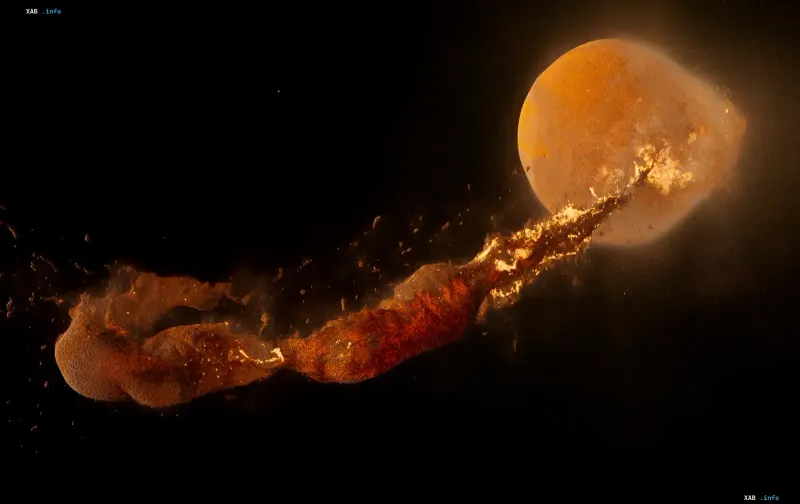
Astrophysicists have presented the results of a new computer simulation that radically changes our understanding of how the Moon was born. According to the study, published in the scientific journal IOP Science, Earth's satellite could have formed just five hours after the collision between the proto-Earth and the protoplanet Theia — a hypothetical object the size of Mars. The work, authored by Dr. Adyn Denton of the Southwest Research Institute in Texas, demonstrates that the temperature and material strength of the colliding bodies exert a colossal influence on the satellite formation scenario, rather than being a secondary factor, as had previously been assumed.
The Classical Hypothesis and Its Limits
The widely accepted giant impact model states that about 4.5 billion years ago, an object called Theia struck the then not-yet-fully-formed Earth. The remnants of the protoplanet partially formed the Moon, while part of them sank deep into the interior of our planet. For a long time, scientists assumed that the energy of the collision was so enormous that the specific geological properties of Theia itself were irrelevant to the final outcome: anything that did not melt simply flew off into space. However, the new simulations completely refute this simplification, showing that the "prior geology" of the proto-Moon and the protoplanet plays a decisive role in the mechanics of the entire process.
Two Scenarios: Slow and Fast
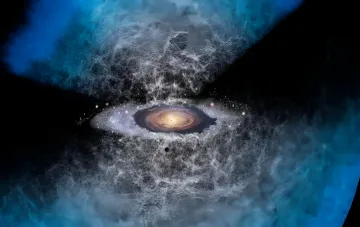
The computer models run by Denton's team revealed two fundamentally different scenarios depending on the temperature parameters. In the "slow" variant, when Earth and Theia were in a high-temperature state, the impact could have completely destroyed the protoplanet and formed a massive debris disk around Earth. From this disk, the Moon formed gradually, over a long period of time. In the "fast" scenario, using parameters with equal internal temperatures for both bodies, a full and intact Moon separated and emerged from the collision debris in just five hours. The difference in outcome is determined by the fact that hot objects are less strong than cold ones, meaning the satellite formation scenarios turned out to be extremely sensitive to the temperature readings at the moment of impact.
Material Strength: The Parameter Finally Accounted For
"When Earth and the Moon are simulated as bodies with specific geological properties, it completely changes the mechanics of their origin after the collision — a detail that was previously considered unimportant," explains Dr. Denton. The scientists emphasize that modern models have evolved and now take material strength into account — a parameter that was previously applied only in the study of small asteroid collisions or the formation of the Pluto–Charon system. As the new calculations showed, for the Moon this factor turned out to be no less important. The concept of rapid formation had already been proposed in a 2022 study, but the new work demonstrated for the first time that it is precisely the combination of material strength and collision temperature that determines whether the Moon will "assemble" over months or separate within hours.
Anomalies Finally Explained
Today, the Moon possesses a number of physical and chemical properties that do not match the classical picture of prolonged formation from a circumplanetary disk. The more flexible scenario proposed in the new work helps resolve these contradictions and explain the existing anomalies in the satellite's composition and structure. In essence, the five-hour "birth" of the Moon from an intact fragment of debris is better consistent with what we observe in its geology today than a centuries-long accretion from a heterogeneous disk. This opens new avenues for testing: if the scenario is confirmed, then the isotopic composition of lunar rocks and their distribution with depth should bear the imprint of precisely rapid separation, rather than slow mixing.
Contradictory Data
The provided sources show a slight discrepancy in wording. RBC-Ukraine and the publication Focus.ua use the precise figure of "five hours" for the fast scenario, whereas the headline on Overclockers.ru reads "in just a few hours." This is not a direct contradiction — "a few hours" may be a generalized journalistic expression for a five-hour interval; however, the precise figure of "5 hours" appears in the description of a specific computational scenario with equal internal temperatures of the bodies. Moreover, the sources emphasize that the concept of rapid formation is not absolutely new — it was proposed as early as 2022 — but it is precisely the new work that for the first time linked it to a specific physical mechanism (material strength), rather than to the general energy balance of the impact.