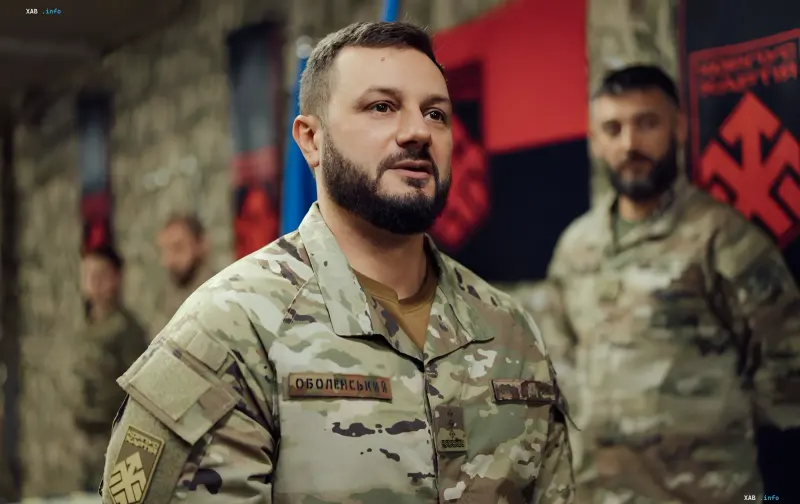
Events at the end of July 2026 sharply increased public attention on the figure of Colonel of the National Guard of Ukraine, Ihor Obolenskyi. On July 31, President Volodymyr Zelenskyy officially announced an assassination attempt on the commander of the 2nd Army Corps. According to the head of state, the attacker and his accomplice were detained, and law enforcement agencies are conducting the necessary investigative actions.
Against the backdrop of this news, details of the officer's biography emerged, whose path to the top of the military hierarchy was not straightforward. In April 2026, Obolenskyi was appointed commander of the 2nd Army Corps, however, his story began long before this appointment.
Education and Business Career
Before the start of the full-scale war, Ihor Obolenskyi had a diverse education. He graduated from the Bohdan Khmelnytskyi Military Institute of Rocket Forces and Artillery in Sumy, as well as obtained master's degrees in law and agronomy.
His career was not limited to the army alone. After leaving the military service in 2019, he engaged in business, holding executive positions at the international agro-industrial company MHP and the Ukrainian agricultural holding 'Agrotrade'. Obolenskyi himself noted that the management experience gained in the private sector subsequently became the foundation for his military activities.
Path Through War: From 2014 to 'Khartia'
Obolenskyi's military path began in 2014. Immediately after the start of the Russian aggression, he served in an artillery brigade of the Armed Forces of Ukraine and the special unit 'Omega'. In 2015, he was appointed commander of the 1st Battalion of the 4th Operational Brigade of the NGU, where he took part in the battles for Kramatorsk and Sloviansk.
However, the decisive stage was the creation of the volunteer formation of the territorial community 'Khartia'. With the start of the full-scale invasion in 2022, Obolenskyi, who had previously moved his family abroad, returned to Ukraine and headed this unit. In 2023, it was reorganized into a full-fledged 13th Operational Brigade of the NGU 'Khartia', and Obolenskyi became its commander.
The name 'Khartia' has a deep meaning: it symbolizes the voluntary union of people who agreed to defend the country until the end of the war, and then return to civilian life. The unit was formed in Kharkiv exclusively from volunteers and went through a combat path in the battles for the Kharkiv region and Bakhmut.
Combat Operations and Strategy
One of the key episodes in the history of the brigade was the transfer of the unit to the Kharkiv direction after the battles in the Serebrianskyi forest. According to the commander himself, the transfer took several hours and took place under constant shelling. It was the actions of the brigade that became one of the factors that allowed stopping the advance of Russian troops in this section of the front.
Obolenskyi actively implements management approaches acquired in business and management principles according to NATO standards in the work of the brigade. In interviews with Ukrainian publications, he repeatedly emphasized that he considers people and trust within the unit to be the main resource of the army. He also talked about the implementation of automated defensive solutions and the use of robotic systems in certain sections of the front.
Personality and Reputation
Military and banker Andriy Onystrat publicly characterized Obolenskyi as one of the strongest organizers of combat work, noting his unique combination of combat experience and management skills. The commander himself pays special attention to the role of women in modern units, especially in working with drones and medical support, noting their attentiveness and discipline.
Talking about the enemy, Obolenskyi expressed the opinion that one of the key factors of pressure on the Russian army is the realization of the protracted nature of the war and the lack of previously announced results. Among the most successful operations, the officer named the liberation of the Kharkiv region and combat operations in the Kherson direction.