
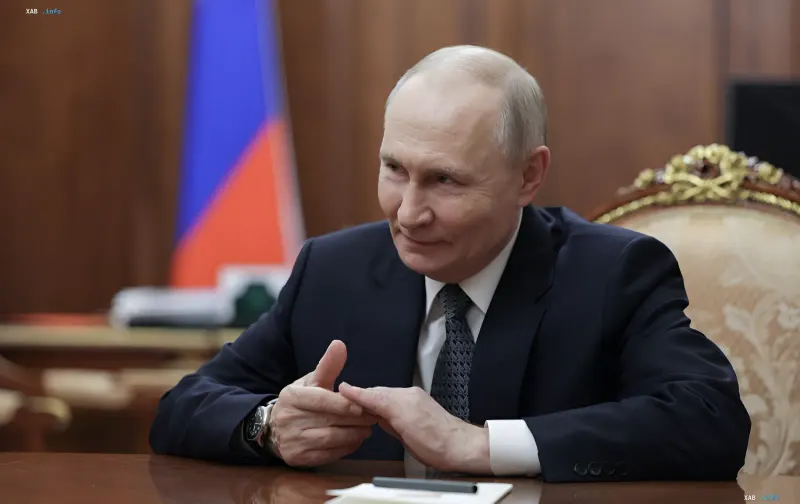
Speaking in his latest report on the state of the nation, Vladimir Putin once again spoke of the "resilience" of the Russian economy. The Russian leader cited a 0.2% GDP growth over the first five months of the year as proof that the economy is holding firm. However, experts and analysts see a very different picture in these figures: near-zero dynamics and worrying signals of an approaching recession.
Budgetary Imbalance and Hidden Problems
In his speech, the Russian leader focused on the federal budget surplus for June, presenting it as a success. At the same time, he intentionally or unintentionally omitted a key fact: by the end of the first half of the year, the Russian budget deficit reached a colossal 5.7 trillion rubles. Such a gap between revenues and expenditures calls into question the country's long-term financial stability.
Separate attention was paid to the growth in lending, which the Kremlin presents as a positive trend. The Center for Countering Disinformation (CCD) points to the other side of the coin: a credit boom indicates not economic development, but a critical increase in the debt burden on the population and businesses. People and companies are forced to borrow money to survive in conditions of inflation and resource shortages.
"See-Saw" for Society
CCD specialists note that the Kremlin's strategy is built on constantly switching public sentiment. "Putin constantly swings his own society on a see-saw — from forced admission of problems to their stubborn and absurd denial the very next day," the center emphasized. Since the start of the full-scale invasion of Ukraine, Russia has effectively been living in a mode of permanent economic crises.
In the opinion of experts, the only way to break this vicious circle is to end the war against Ukraine. The decision to do so, paradoxically, depends solely on the will of Vladimir Putin.
Reality Beyond Official Rhetoric
The problems of the Russian economy have long gone beyond simple deficits. Analysts from the Institute for the Study of War (ISW) link the current collapse to record military spending, high inflation, and the depletion of gold and foreign exchange reserves. The situation is so critical that the authorities are forced to resort to administrative measures to create the appearance of stability.
As reported by Reuters, to maintain the illusion of calm in Moscow, the Kremlin has redirected gasoline supplies to the capital, leaving other regions of Russia with a fuel shortage. To do this, Russia was forced to increase fuel imports from Belarus, start purchasing in India, and redirect flows from the Urals and Siberia. These measures only confirm that the country's economy is in a deep crisis that cannot be hidden even by the most optimistic statements.