August 11, 2026 — New York/Amherst. The scientific community has received new evidence that modern language models, no matter how sophisticated they may seem, operate according to fundamentally different laws than the human brain. A joint study by researchers from New York University (NYU) and the University of Massachusetts Amherst (UMass Amherst), published in the prestigious journal Proceedings of the National Academy of Sciences (PNAS), reveals a critical difference in how artificial intelligence and humans process textual information.
The Math of "Surprisal" vs. Cognitive Flexibility
The foundation of modern neural networks is the concept of predicting the next token (word or part of a word). Algorithms assess the probability of a specific word appearing based on the preceding context, using a mathematical metric called "surprisal." This indicator reflects the degree of unexpectedness of a word for the model. If a word logically follows from the context, the "surprisal" is low; if it stands out, it is high. For a long time, it was believed that this parameter was a universal marker of text complexity for any reader, whether human or machine.
However, new data refutes this hypothesis. Researchers have established that "surprisal" cannot fully capture the complex cognitive processes occurring in the human mind. The brain does not simply calculate probabilities; it actively reconstructs the understanding of the text, and this process does not always depend linearly on the statistical unexpectedness of a word.
Where Statistics End and Comprehension Begins
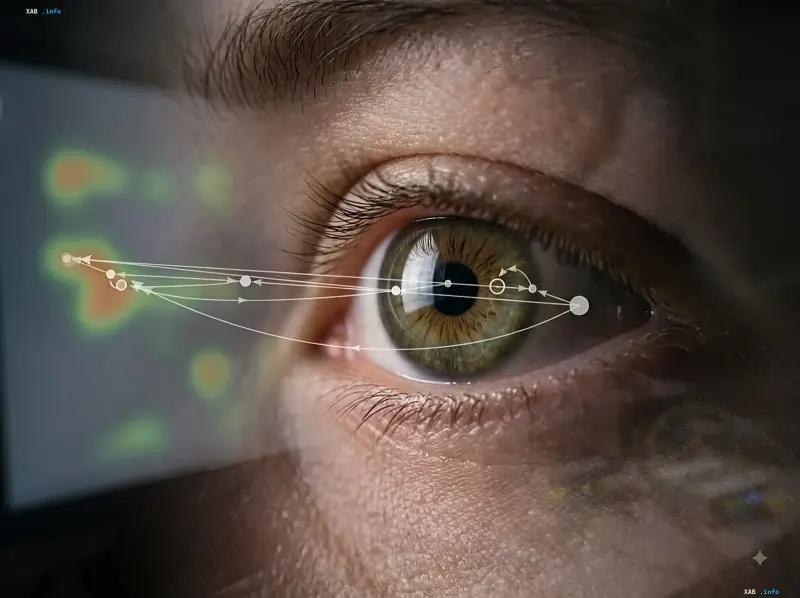
The key finding of the study lies in the difference between reading phases. Scientists confirmed that the statistical predictions of neural networks do indeed correlate well with the process of initial rapid reading. When a person sees a familiar word or a simple phrase, their reading speed and eye fixation time do indeed correspond to the AI's "surprisal" metric. In this aspect, machines successfully imitate human perception.
The situation changes radically when encountering complex structures. The study showed that the "surprisal" metric cannot predict re-analysis of the text (eye regressions). When a person encounters a complex sentence, they instinctively look back, reread fragments, and reconstruct the syntactic structure of the sentence in their mind. Neural networks operating in autoregressive mode do not go "back" — they move only forward, and their mathematical model does not account for this critical phase of error correction and deep understanding.
Contradictory Data and Limits of Applicability
There are different viewpoints in the scientific community regarding the interpretation of this data. On one hand, proponents of AI metrics dominance argue that with sufficient data, neural networks will inevitably learn to imitate regressive eye movements, simply averaging them into their weights. On the other hand, the authors of the study from NYU and UMass insist that the probability of the next token cannot be used as the sole equivalent of human perceptual complexity.
This contradiction is important for understanding the nature of intelligence. If AI simply predicts a word, while a human builds a mental model of meaning, then "surprisal" for AI is a measure of information entropy, while for humans it is a measure of cognitive load. Mixing these concepts can lead to erroneous conclusions about how "understandable" a text is for a real user.
Implications for Interface Development and Education
The results of the work have practical significance for software developers, especially in 2026, when personalized interfaces and educational platforms are becoming the standard. The authors of the study warn: when creating systems to assess interface readability or programs to help people with dyslexia and other reading difficulties, one cannot rely solely on autoregressive probabilities.
To create truly human-friendly systems, developers will need to implement mechanisms for structural analysis and tools for detecting syntactic errors. This will allow text complexity to be evaluated not by how easily a machine can predict it, but by how much effort it will require from a human to comprehend it and correct errors in understanding.