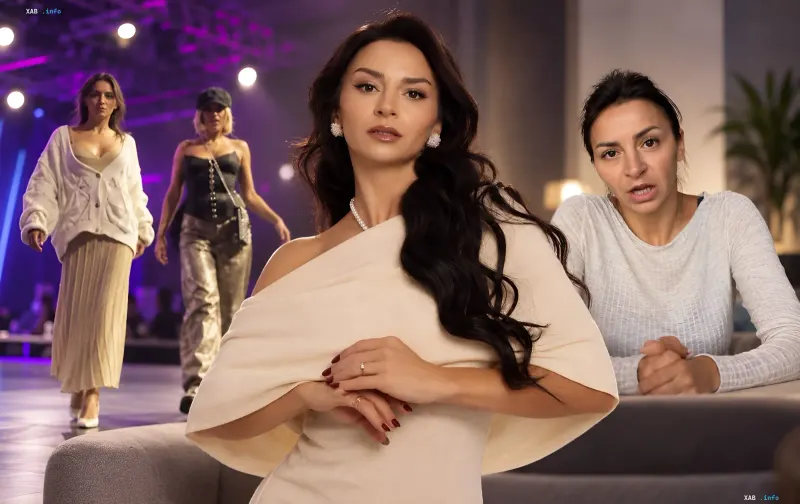
Ukrainian choreographer Ilona Hvozdeva found herself at the center of a public controversy after publishing an Instagram reel featuring her dancing to the track White Horse. The video, which initially seemed unremarkable, quickly attracted audience attention due to the origin of the choreographic trend: users linked it to dancer Polina Glend, who lived and worked in St. Petersburg at the beginning of her career. The comments section was flooded with criticism accusing her of promoting Russian content, to which Hvozdeva responded with a detailed video message outlining the results of her own investigation.
Reason for discussion: Viral trend and its origin
The reel that triggered the discussion shows Hvozdeva performing smooth, expressive movements in a runway style reminiscent of fashion shows traditionally filmed on the streets of Los Angeles and New York. The musical accompaniment was the track White Horse performed by the project Wonderland Avenue. According to the choreographer herself, the basis of the track was a song by the Danish duo Laid Back, released in 1983, which subsequently received a number of new versions and became actively used on social media. Hvozdeva stated that this musical foundation has nothing to do with the Russian cultural space.
Audience reaction: From irritation to calls for self-censorship
Some subscribers noticed that the choreography performed by Hvozdeva is associated with Polina Glend, a dancer who lived in St. Petersburg for a long time and started her professional career there. Comments appeared such as "Are you out of your mind? This is a Russian woman's trend" and "It would be great not to spread rashi's trends." One subscriber left a detailed post suggesting that Hvozdeva, as a choreographer, create her own dance to the same track instead of repeating someone else's choreography, calling this approach "super dignified." Overall, the tone of the discussion boiled down to urging the Ukrainian artist to abandon content that critics believe has Russian origins.
Video message: Hvozdeva conducts her own investigation
Instead of deleting the video or ignoring the criticism, Hvozdeva recorded a separate video message detailing exactly what she verified before expressing her position. The choreographer reported that Polina Glend was born in Kazakhstan, grew up in St. Petersburg, and by 2016 already ran her own dance studio in that city. Later, Glend moved to the United States, where she continued her professional activities. Hvozdeva emphasized that during her search, she found no public confirmation of Glend collaborating with Russian artists, nor any information about her performing or holding master classes in Russia after the start of the full-scale invasion.
Nuances that Hvozdeva did not keep silent about
At the same time, the choreographer did not hide details that could be interpreted ambiguously. She acknowledged that Polina Glend's website features a Russian-language training program for choreographers, as well as information on payment via Russian bank cards. "Should this be considered cooperation with Russians? Everyone decides for themselves," Hvozdeva formulated, without forcing a definitive conclusion on viewers. In addition, she noted that she found no public statements by Glend in open sources—neither supporting nor opposing the war. In the opinion of the Ukrainian choreographer, the combination of these facts does not provide grounds to automatically attribute loyalty to Russia based on a single dance video.
"Vigilance means checking first, not throwing stones"
Concluding her message, Hvozdeva drew attention to the paradox of the situation: if she herself, as a choreographer who regularly works with trends, did not know the authorship of this specific dance, why did viewers identify it so promptly and confidently as "Russian"? The choreographer did not deny the importance of vigilance under wartime conditions, but insisted that it should manifest in fact-checking rather than public hate and accusations of treason. "Vigilance during the war is, of course, the right thing. But vigilance means checking first, rather than pelting a person with images, treasons, and hate," Hvozdeva summarized. The video with her explanation was not deleted from the network, which essentially served as an additional signal: the choreographer does not intend to apologize for what she believes is not a violation.
Context: Trends, boundaries, and public responsibility
The situation with Hvozdeva illustrates a broader conflict that regularly arises in the Ukrainian media space: where does the line lie between a neutral cultural product and content that is automatically labeled as "Russian" during wartime. Social media dance trends are transnational by nature: choreography migrates between platforms, transfers to new tracks, and is performed by artists from various countries. In this case, the musical foundation is Danish, the choreographic style is runway, and the trend creator is a Kazakh woman who lived in Russia before moving to the US. Nevertheless, the geography of Glend's early career was enough for part of the audience to ascribe a "Russian" origin to the entire complex. Hvozdeva, in turn, tried to shift the focus from emotional reaction to factual verification, inviting viewers to independently determine what is permissible for them and what is not.