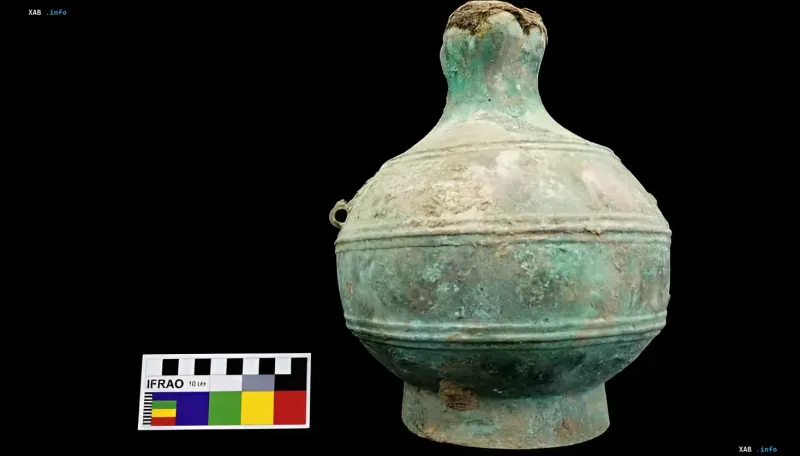
A debate is brewing in the scientific community regarding a unique discovery made in northwestern China. An international team of archaeologists and biochemists has completed a detailed analysis of the liquid contents of an ancient bronze vessel found at the Shanjia Bao cemetery in the Ningxia Hui Autonomous Region. Inside the hermetically sealed container, scientists discovered 3.74 liters of an alcoholic beverage that has remained virtually unchanged for more than two millennia.
A biochemical time capsule
The find dates back to the Warring States period (the Qin state era, 475–221 BC). Scientists believe the vessel was left in the tomb as a ritual offering intended to accompany the deceased into the afterlife. The liquid, which has a pale bluish-green tint, managed to survive the millennia thanks to unique conditions: a tight textile stopper, external clay insulation, and the region's dry climate.
The results of the study, published in the journal Journal of Archaeological Science: Reports, are remarkable in their detail. Inside the vessel, a true microcosm was discovered: more than 2,400 organic compounds, about 100,000 starch grains, and more than 8,500 yeast cells. The high concentration of lactic and oxalic acids became key evidence that what the researchers were looking at was a product of deep cereal fermentation, not groundwater that had seeped into the sarcophagus.
Technological breakthrough of ancient masters
An analysis of the wort composition showed that the base of the beverage (about 92%) was millet, with a small addition of wheat and barley. To initiate the fermentation process, the traditional starter "Qu" was used — a complex mixture of mold fungi, beneficial bacteria, and yeast. This discovery is of fundamental importance to the history of technology: it confirms that the masters of ancient China already possessed the method of simultaneous starch saccharification and fermentation.
While European technologies of that period required long and separate malting, Chinese distillers created a biodynamic ecosystem capable of performing both functions at once. It is precisely this method that still forms the basis of the production of traditional yellow wine (Huangjiu). According to researchers' estimates, the drink did not have a sharp smell and represented a thick, cloudy, slightly sweet-and-sour nectar of moderate strength.
Contradictory data
During the analysis, interesting discrepancies arose between archaeological data and written sources. All ancient Chinese chronicles that have survived to this day claimed that elite alcohol during the Warring States period was produced exclusively from rice. However, the find from Shanjia Bao, where millet was packed in an expensive bronze vessel for the nobility, casts doubt on these claims.
Scientists suggest that this may indicate the existence of a unique, independent recipe in northern China, in the state of Qin, which was previously considered "low-grade" but, in this context, possessed a sacred significance. Furthermore, there are discrepancies in the figures: initial reports mentioned more than 2,000 organic compounds, whereas in-depth laboratory analysis revealed more than 2,400 components, which speaks to the complexity of the chemical composition of the ancient beverage.