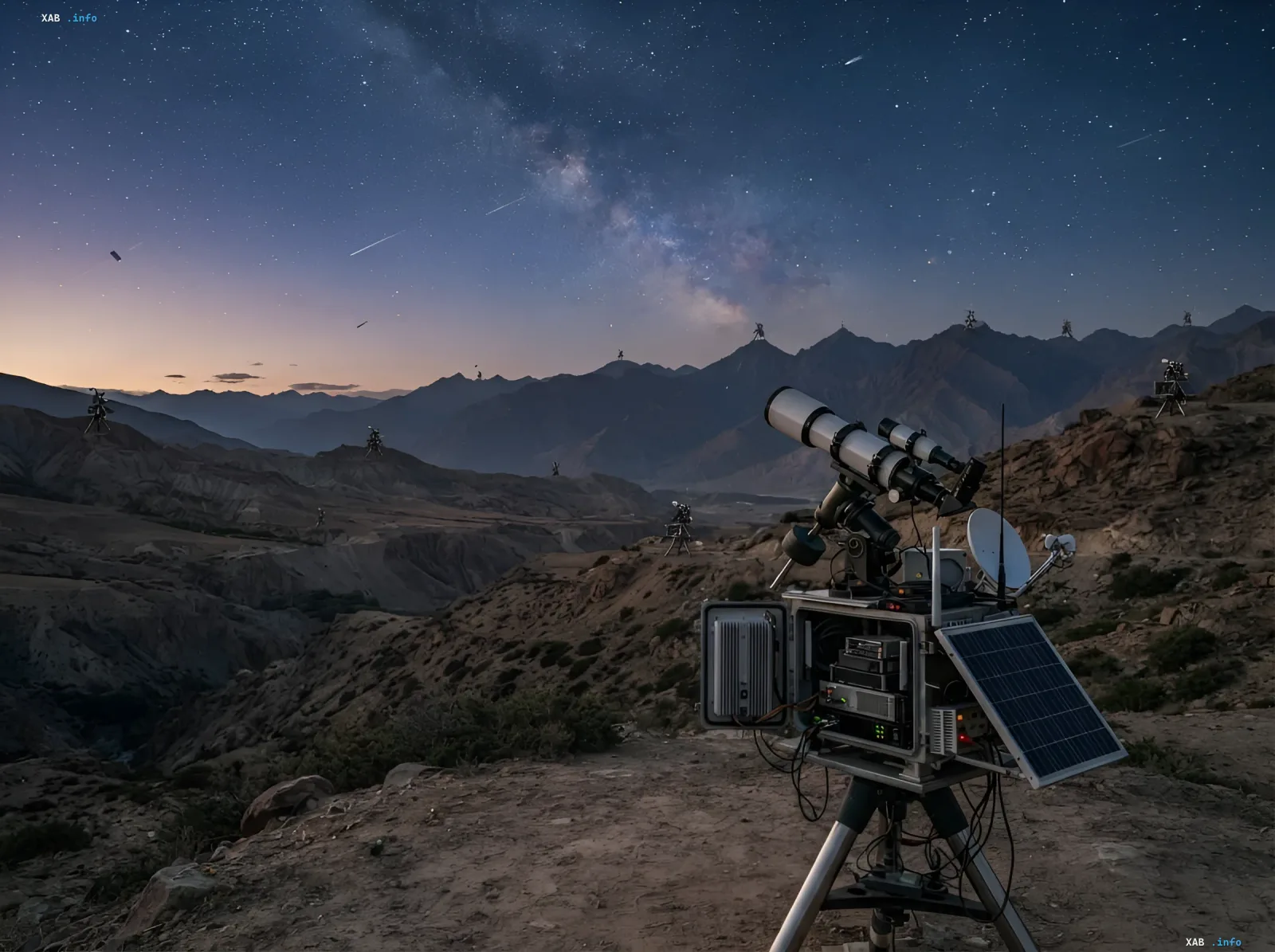
Bangalore-based company Digantara has unveiled the MOSAIC (Wide Area Sensing Architecture) system — a distributed network of optical sensors with artificial intelligence components, designed for the detection, tracking, and analysis of objects in low Earth orbit (LEO). Unlike conventional telescopes, which are pointed at a pre-known object, each MOSAIC node continuously scans its assigned sector of the sky and uses machine learning algorithms to separate background stars from moving space objects, including faint ones. The initial deployment comprises five nodes, which are coordinated as a single network.
Node architecture and field autonomy
Each system node consists of two main parts: a wide-field optical block and an electronic block responsible for onboard computing, synchronization, and communication. Power is supplied by solar panels with buffer batteries, and the equipment's climate resilience is designed for a wide range of conditions — from the heat of the Thar Desert to Himalayan winters. This design allows sensors to be deployed in remote locations without permanent power and communication infrastructure, which is critical for a distributed architecture.
The "lost-in-space" method and independence from external targeting
A key technical feature of MOSAIC is the "lost-in-space" technique: after detecting an object, the system determines its coordinates without prior information about its position and without external targeting. This allows tracking of objects whose orbit is unknown or has changed unexpectedly — for example, after a maneuver, a failure, or disintegration. It is precisely this approach that distinguishes MOSAIC from databases tied to pre-known satellite catalogs.
Scaling and strategic context
Digantara has announced plans to deploy more than 1,000 nodes within 24 months. Among the stated applications are celestial navigation in the absence of GPS and ensuring India's independence from foreign sources of space intelligence. According to reports by India Today and The Print, one of the project's triggers was the country's identified dependence on external data during Operation Sindoor, which prompted the creation of its own near-Earth space observation loop.
Contradictory data
Here it is important to separate the confirmed from the claimed. In fact, five nodes have been deployed, while the plan of 1,000+ nodes in 24 months remains a company announcement and is not confirmed by independent sources. Moreover, Digantara does not publish efficiency benchmarks, false alarm rates, or information about the training datasets of its AI models. For machine learning and synchronization engineers, questions of calibration, sensor metadata, and track fusion quality in a distributed architecture remain open. Thus, the system's claimed capabilities have not yet been verified by public tests.