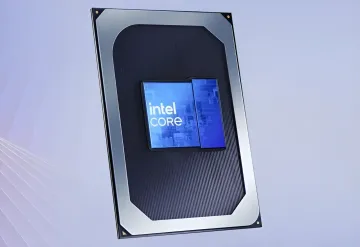
Public photos of a pre-production engineering sample of an Intel Razor Lake-AX processor (Core Ultra 5000 family) have for the first time clearly confirmed the unusual layout of the future platform. On the same substrate as the rectangular central compute die, there are four contact pads, presumably intended for DRAM memory chips. The logic of the placement mirrors that of graphics cards, where memory modules are mounted around the GPU. The images appeared on a Chinese secondhand marketplace and were circulated by leaker HXL on social media, as reported by NotebookCheck; further details on the layout and specifications are provided in reports by VideoCardz.
Memory on the Substrate: From Two Lunar Lake Modules to Four
Intel has already used a similar approach in Lunar Lake models, where two LPDDR5X memory modules were placed on the substrate next to the compute die. In the case of Razor Lake-AX, the number of pads has been doubled to four, which is estimated to increase the memory bus width to 256 bits. This design shortens the distance between the processor and memory, reduces system footprint, and potentially increases efficiency. It is noted that the compute die in the photos appears monolithic, whereas Lunar Lake uses a multi-die topology; this may indicate that this sample is a dummy unit for cooling system checks or mechanical testing.
32 to 128 GB and a Four-Channel Controller
According to VideoCardz, the Razor Lake-AX platform will support 32 to 128 GB of RAM and feature a four-channel controller. A fundamental difference from common solutions will be the supply scheme: Intel plans to provide partners with processors without pre-installed memory chips, with DRAM assembly to be performed directly by computer manufacturers. Thus, the four memory modules on the substrate will not be a finished component, but a base to be finalized by the OEM.
Up to 32 Cores and Direct Competition with AMD Halo
Razor Lake-AX is expected to feature up to 32 compute cores and will compete with the AMD Halo series of processors, which also use DRAM (LPDDR5X) integrated into the platform design. Integrating memory onto the substrate reduces system size and shortens the distance between the processor and memory, which, according to the developers, improves efficiency. Thus, both companies are betting on compact, high-performance platforms with "on-board" memory.
Timeline and Status: What is Known So Far
The first devices based on Razor Lake-AX could appear in the third quarter of 2027, according to preliminary reports. Intel has not yet officially unveiled this lineup, so all specifications, memory capacities, and launch dates remain preliminary and based on leaks and engineering samples. The publication of photos of the pre-production chassis has become an important confirmation of previous rumors about the unusual layout of future Intel processors; however, the final specifications will only be known after the company's official announcement.