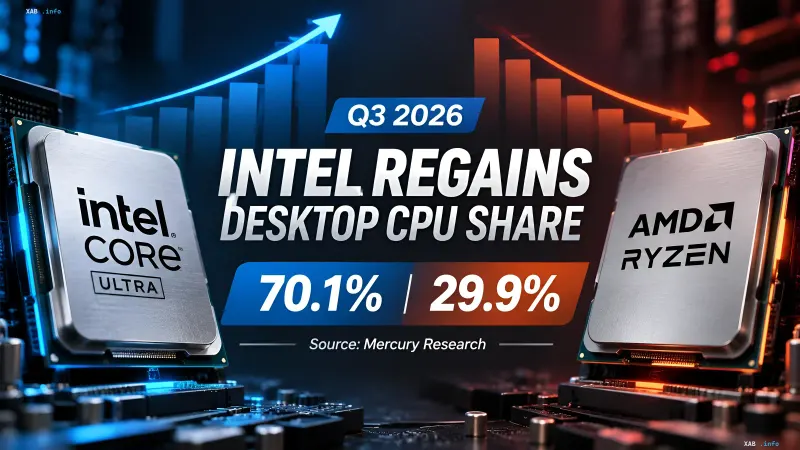
According to analytical firm Mercury Research, Intel demonstrated one of the sharpest quarterly surges in the desktop processor market in several years during the third quarter of 2026. The company's share in the desktop CPU segment grew from 65.1% in the second quarter to 70.1% at the end of the third, representing a gain of 5 percentage points in 90 days. For context, Intel had steadily lost market share to AMD for an extended period, and analysts describe such a trend reversal in such a short timeframe as anomalous.
Quarterly Growth Amid Annual Stagnation
It is important to distinguish between the two time scales provided in Mercury Research's report. On a quarterly basis, Intel's momentum looks impressive: +5 percentage points in a single reporting period. However, the annual perspective is much milder. A year earlier, in the third quarter of 2025, Intel's share of the desktop market stood at 66.4%. Thus, compared to the same period last year, the increase is only about 3.7 percentage points, and it is the quarterly momentum that makes the news truly notable for the industry.
Server Segment and Overall Market: AMD Still on Top
Despite the impressive shift in the desktop segment, Mercury Research emphasizes that in the server segment and the broader processor market, AMD continues to capture market share from Intel on an annual basis. In other words, Intel's desktop surge does not alter the overall competitive landscape: in data centers and enterprise solutions, AMD maintains its upward trajectory, while Intel's total share across the entire processor market continues to decline. This means Intel's "comeback" remains localized and restricted to a single segment.
Analysts Admit: Causes Are Not Fully Clear
Even those tracking the shift acknowledge its unexpected nature. Mercury Research analysts, in a comment cited by iXBT, explicitly state that they do not fully understand what exactly triggered such a sharp change in consumer behavior within the desktop market. This is a rare situation for an industry where most quarterly shifts are explained by new product launches, pricing campaigns, or platform transitions. The lack of a single "explaining factor" makes the current momentum a subject of intense discussion in technical communities.
GPU and Memory Prices as a Possible Factor
One working hypothesis discussed in the context of the Mercury Research report links the shift to pricing conditions for related components — graphics cards and RAM. The logic is as follows: AMD traditionally holds strong positions in the desktop segment precisely because of its Ryzen gaming processors, which target enthusiast PC builds. If users cut back on purchasing gaming systems — partly due to high prices for graphics accelerators and DRAM — demand for AMD desktop CPUs may decline disproportionately more than Intel's offerings, which have a broader base in office, creative, and "mass" segments. Consequently, Intel may be winning not so much through its own product breakthrough as through a structural shift in demand toward less "gaming-centric" configurations.
What This Means for the Market
Intel's quarterly rebound to 70.1% is undeniably a notable signal, but its interpretation requires caution. On one hand, it may indicate that the Core Ultra lineup (referenced by the markings on the processors in the report) has resonated with consumers in a segment where AMD has not historically dominated. On the other hand, if the shift is driven by a temporary compression of gaming demand due to price pressure on GPUs and memory, the momentum could reverse once component prices stabilize. Mercury Research will continue tracking figures in the fourth quarter of 2026, and that specific report will be key to determining whether the current surge marks the beginning of a sustainable trend or a one-time anomaly.