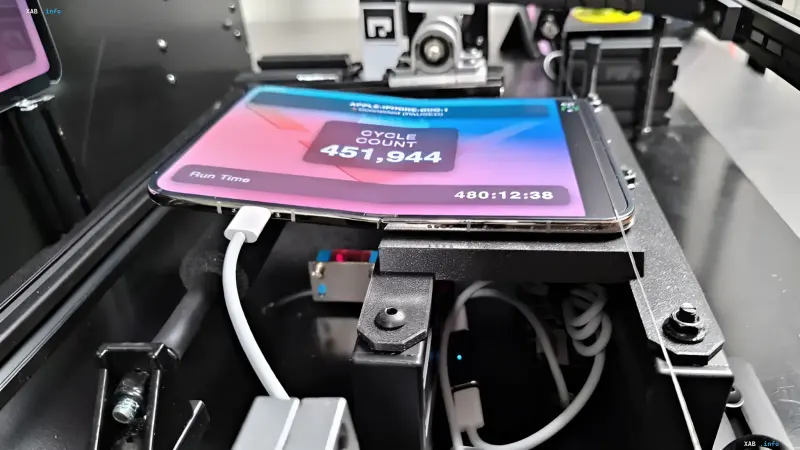
Apple's foldable iPhone Duo, which has been undergoing continuous automated folding tests on a Fold-a-Phone machine for several weeks, has begun showing the first signs of wear in its folding mechanism. According to CNET, by the time the issues were recorded, the device had gone through approximately 440,300 folding and unfolding cycles. The hinge stopped opening completely on its own: after the testing machine stopped pulling the screen, the smartphone remained slightly compressed, failing to reach a fully flat position.
First Signs of Hinge Fatigue
The first deviations from standard mechanism behavior were noticeable even earlier—around the 390,000 cycle mark. According to CNET's observations, the hinge began operating less smoothly, and the characteristic sound accompanying screen unfolding effectively disappeared. At this stage, the smartphone still straightened out almost entirely by inertia right after the machine stopped applying force, so the wear did not look critical and did not stop the test.
What Is Happening to the Hinge Now
Noticeable deterioration was recorded between 440,000 and 440,300 cycles: the folding mechanism began to "stall," leaving the screen at an angle of about 5–10 degrees from a flat position. At the same time, the smartphone can still be fully opened manually by pressing the screen all the way down. Importantly, no actual hinge failure has been recorded at this point: the display works, other unfolding positions are locked without problems, and no visible cracks, screen damage, or noticeable deepening of the crease on the panel have been detected.
How This Translates to Real-World Years
The tests are conducted on a special Fold-a-Phone machine that automatically and continuously folds and unfolds the device. According to CNET's estimate, by the time the first problems appeared, the iPhone Duo had undergone stress equivalent to approximately 12.5 years of daily use at a rate of 100 folds per day. Apple has not officially disclosed the stated lifespan of the iPhone Duo folding mechanism, so the manufacturer has not confirmed an exact "limit" figure for cycles. In the published frame of the test setup, the cycle counter already exceeds 450,000, indicating that the test is still ongoing.
What This Means for Foldable Smartphone Owners
The results of the CNET test should be taken as data on the fatigue of a specific unit under accelerated laboratory conditions, rather than as a guaranteed lifespan for every iPhone Duo. Nevertheless, the observation shows that a foldable smartphone's hinge is a component that loses rigidity and locking precision over time, even in the absence of visible damage. For buyers of foldable devices, this is an additional argument to monitor the condition of the hinge and not force the mechanism, and for the industry, it is another public durability benchmark that manufacturers do not yet back up with official specifications.