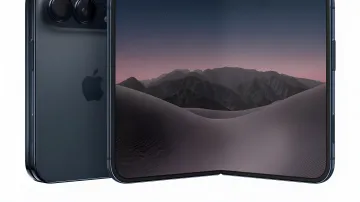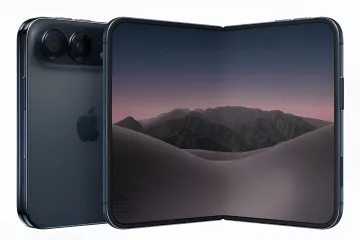
Time magazine featured Apple CEO John Ternus on the cover of its new issue and included the iPhone Duo foldable smartphone in its list of the best inventions of 2026. Accompanying the cover story is an extensive interview in which the Apple chief details for the first time the company's multi-year journey toward a foldable form factor, why competitors failed to impress him in the early stages, and the prospects for artificial intelligence within the Apple ecosystem. The publication coincided with the launch of pre-orders for the iPhone Duo, which have already sparked overwhelming demand and pushed delivery windows back by several months.
The 2011 Patent and Skepticism Toward Rivals' Prototypes
Ternus revealed that he participated in Apple's early research into foldable devices back in 2011, when simple flip phones dominated the market. At that time, he and five other engineers filed a patent application for foldable electronic devices, studying what batteries and circuit boards would be required to realize the concept. „It was becoming clear that OLED displays would eventually become flexible,“ the Apple chief recalled. However, he remained skeptical of competitors' first commercial foldable smartphones that appeared in the 2010s: „other such solutions felt cheap and nasty.“ According to Ternus, this very skepticism defined Apple's strategy — not to rush until the solution was truly correct.
Nanotexture and a Hinge Made of a Hundred Components
Apple Vice President of Product Design Richard Dean explained in the interview how Ternus influenced the team's approach to materials. Once, Dean asked whether they should use a material for the outer coating similar to what competitors were using — despite some flaws, it was reasonably good. „And he said, ‚Listen, Rich, when the solution is right, you'll know.‘ That gave us the confidence to push beyond conventional notions of innovation and manufacturing; we flew around the world, pooled supplier resources, and developed the nanotexture,“ Dean recalled. The result of years of work was a display surface made of a specially engineered polymer and a hinge consisting of more than a hundred high-precision internal components. According to early users, seeing the crease on the iPhone Duo screen is practically impossible.
AI and Next-Generation Siri
In the interview, Ternus also touched upon artificial intelligence. He emphasized that Apple has no need to create all AI service components independently — it is more important for the company to stand out from competitors. According to him, the next-generation Siri AI assistant will help users whose lives „have found reflection almost entirely in the phone“ use accumulated information to accomplish tasks, gain new knowledge, and find solutions „in a way no one else can.“ Thus, Apple is betting not on developing every neural network module independently, but on integration and the uniqueness of the user experience.
Frenzied Demand and Scalpers on eBay
The iPhone Duo has not yet hit open retail sales, but pre-orders, which opened on the eve of the interview's publication, have already caused expected delivery times to shift from late October to November, December, January, and in some countries, particularly Brazil, to February. On eBay, scalpers are already offering the device for up to $10,000. Apple assured: „We are working hard to get this revolutionary product into the hands of our customers as quickly as possible, and online orders remain open.“ Consumers, in turn, are urging the company to identify and cancel orders placed by scalpers.
„Adrenaline, Caffeine, and Anticipation“
Ternus concluded the interview with a personal story. On the night before his first presentation as CEO of the company, he was unable to sleep. He attributed the reason to „adrenaline, caffeine, and the anticipation of the day.“ Early in his tenure as Apple chief, Ternus devoted immense attention to design, spending several days a week in the studio with hardware and user interface developers — an approach that is apparently embedded in the creation philosophy of the iPhone Duo itself.